

The first session is NOT where the patient journey begins.
It starts earlier, in the intake process. That’s where prospective patients decide whether moving forward feels easy, confusing, or not worth the effort.
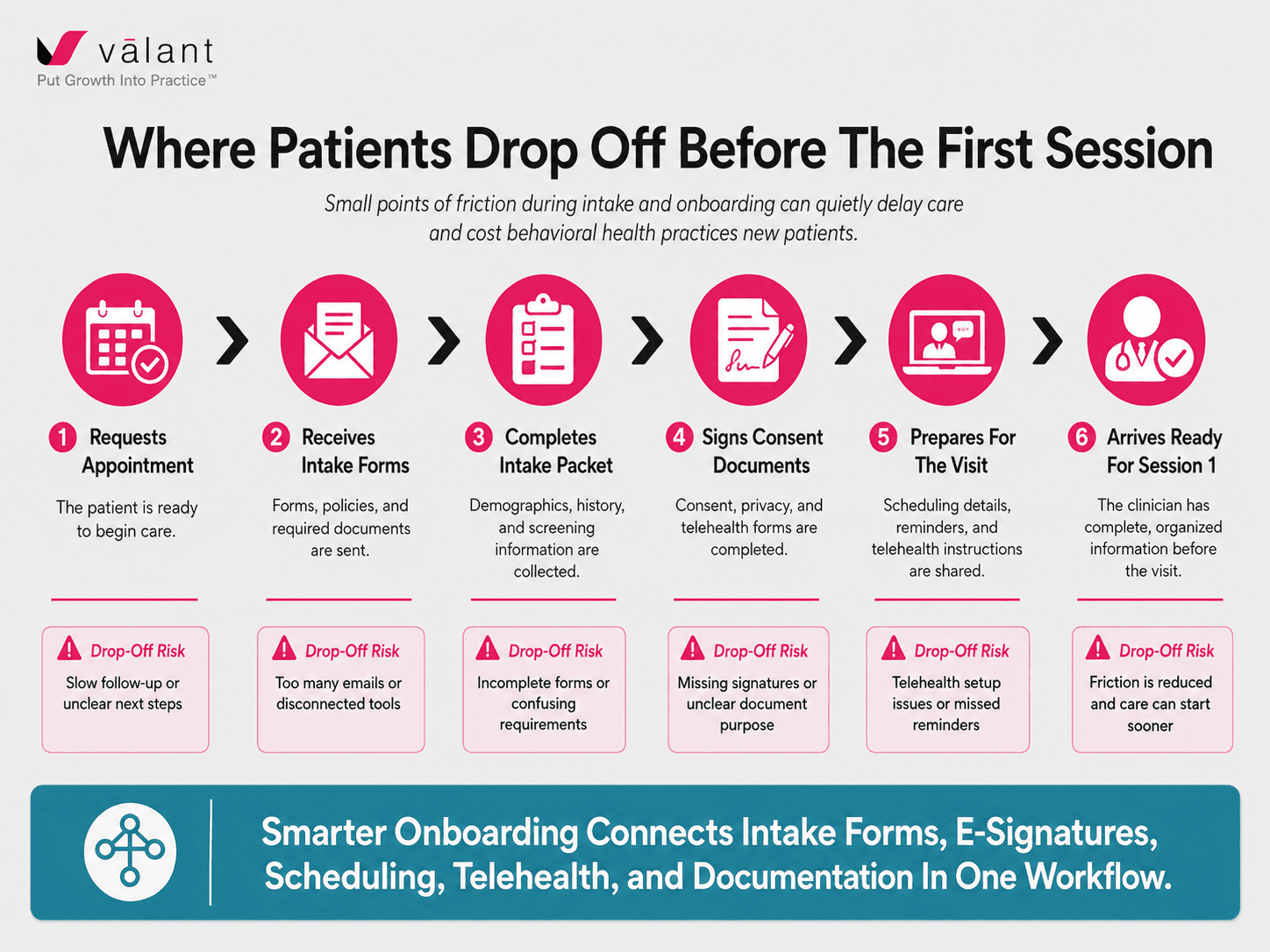
For behavioral health practices, that moment carries more weight than many teams realize. When intake forms are incomplete, signatures are delayed, telehealth instructions are unclear, or staff have to chase paperwork across email and PDFs, patients can drop off before care ever begins.
That’s not just an operational frustration. It’s a growth problem, a patient experience problem, and often a revenue problem.
Many practices focus heavily on what happens in session, but a surprising amount of friction builds before the first appointment. A patient may need to complete intake forms, review policies, sign consent documents, confirm demographics, provide insurance information, and prepare for telehealth. If those steps live across disconnected systems, the intake experience becomes more difficult than it should be.
A smarter onboarding process helps remove that friction. When intake forms, consent documents, scheduling, telehealth, and documentation all work together in one environment, your practice reduces drop-off, improves readiness for the first visit, and scales without adding more administrative burden.
The Hidden Cost of Intake Friction
Behavioral health practices often see the same problems repeat themselves during onboarding:
- New patients disappear before their first appointment
- Intake packets come back incomplete
- Staff spend time sending reminders and chasing signatures
- Teams manually scan, upload, and re-enter paperwork
- Clinicians receive inconsistent information across patients
- Telehealth setup creates last-minute confusion
- Documentation varies from provider to provider
- Compliance risks increase when documents are handled across disconnected tools
Each issue may feel small on its own. If one or more exist together, they create a slower, more fragile intake process that’s harder to manage as the practice grows.
This is especially important in behavioral health, where each individual’s decision to get help already feels vulnerable and difficult. When the first few steps are confusing or time-consuming, practices risk losing people before treatment even begins.
Why Intake and Onboarding Break Down
In many practices, intake still depends on too many manual handoffs. A form is emailed. A signature is requested separately. A scheduler follows up by phone.
Telehealth instructions are sent later. Administrative staff try to confirm whether everything has been completed. Clinicians may not know what is missing until shortly before the visit.
That kind of workflow makes it harder to answer basic questions quickly:
- What are the required intake documents for this patient?
- Which forms are still missing?
- Has informed consent been signed?
- Is the patient ready for telehealth?
- Is the record complete enough for the first session?
When those answers are not clear in one place, onboarding slows down.
Smarter Intake Starts with Connected Workflows
A better intake process doesn’t just digitize paperwork. It connects the entire onboarding workflow so patients and staff aren’t navigating separate systems for forms, signatures, communication, scheduling, and care delivery.
That’s where tools like intake and assessment automation make a meaningful difference. When forms are delivered digitally, returned securely, and tied directly to the patient record, your practice reduces manual work and improves consistency from the start.
Instead of relying on back-and-forth emails and scanned PDFs, patients can receive documents through a secure client portal, complete required forms, sign electronically, and move through the onboarding process with fewer delays. Staff can see what’s been completed, what’s still outstanding, and what needs attention before the first appointment.
That kind of visibility matters. It helps your team move patients from intake to scheduling to telehealth with fewer missed steps.
Intake Forms and Informed Consent Are NOT the Same Thing
One common source of confusion is the difference between intake paperwork and informed consent.
- An intake form typically gathers the information needed to begin care. That may include demographics, insurance details, presenting concerns, history, medications, emergency contacts, screening questions, and other practice-specific information.
- Informed consent serves a different purpose. It documents that the patient understands the nature of treatment, relevant policies, privacy practices, risks, responsibilities, and how care will be delivered. In telehealth settings, practices may also need specific telehealth consent language.
When these documents are handled inconsistently, practices create unnecessary risk. Patients may complete clinical intake details but miss a required consent. Staff may think onboarding is finished when key signatures are still outstanding.
A more structured intake workflow helps separate these document types clearly while still delivering them in one connected experience.




How eSignatures Reduce Intake Delays
Practices often ask whether eSignatures are legal for intake and consent forms in healthcare. In general, electronic signatures are widely used for these workflows when they are handled through secure, compliant systems and aligned with applicable organizational and legal requirements.
Operationally, the bigger issue isn’t typically legality; it’s speed.
When patients can sign intake and consent documents electronically, practices reduce the lag created by printing, scanning, emailing, and resending forms. Staff spend less time following up, and patients have a more straightforward path to completing onboarding.
That matters even more for telehealth. If a patient is expected to complete intake forms, sign consent documents, and prepare for a virtual appointment, the process needs to feel clear and manageable. Otherwise, telehealth’s convenience is undermined by immediate friction.
Standardization Matters as Practices Grow
Growth puts pressure on intake in ways many practices don’t expect. More providers means more variation. More locations or service lines means more routing complexity. More patient volume makes manual follow-up harder to sustain.
Without standardization, one clinician may collect a complete, well-structured intake packet while another receives partial information. One scheduler may follow the intended process while another uses workarounds. Over time, the patient experience becomes inconsistent, and documentation quality can drift across the team.
Role-based workflows and centralized intake data help create a better foundation. Practices can standardize what’s required, how forms are delivered, how documentation is routed, and where completed information lives. Clinicians still need flexibility, but the intake process should not depend on individual improvisation.
This becomes even more important at scale. Larger practices often benefit from clear operational rules for routing, scoring, or prioritizing intake steps, especially when different programs, clinicians, or patient types require different workflows. If you’re managing a higher-volume environment, this article on best practices for managing the patient intake process is a useful companion read.
Better Onboarding Also Improves Matching and Readiness
A stronger intake process goes beyond collecting paperwork. It improves clinician readiness before the first session.
When intake data is centralized and accessible, clinicians can review patient information earlier, prepare more effectively, and begin treatment with fewer administrative distractions. That also supports better matching decisions when practices need to connect patients with the right therapist, service type, or care path. For teams refining that process, this guide to matching new patients with your therapists adds helpful context.
The end goal is not simply efficiency. It’s a smoother first experience for the patient and a more prepared starting point for the clinician.
A Better First Impression Supports Long-Term Growth
Behavioral health practices don’t lose patients only because of clinical fit. Sometimes they lose them because the path to care feels slow, fragmented, or unclear.
Smarter intake and onboarding help reduce that risk. They shorten the time to the first session, reduce back-and-forth, strengthen compliance, support more consistent documentation, and make growth easier to manage. Most importantly, they help practices remove friction at the exact moment when patients need a clear next step.
If your intake process still depends on manual paperwork, disconnected tools, or staff workarounds, it may be costing more than it appears.
See How Connected Intake Can Reduce Drop-Off BEFORE the First Visit
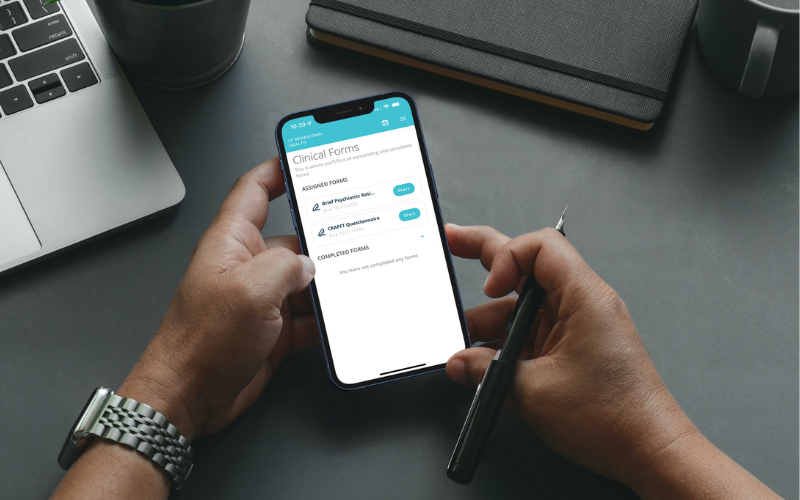
Valant helps behavioral health practices connect digital intake forms, secure document sharing, eSignatures, scheduling, telehealth, and documentation in one environment. That means less document chasing, fewer onboarding bottlenecks, and a more consistent experience for both patients and staff.
Explore our Intake & Assessment Automation page to see how a more connected intake workflow can help your practice reduce drop-off, improve readiness, and scale with less administrative burden.
Frequently Asked Questions About Patient Intake Processes
Behavioral health practices often have the same questions when they’re trying to improve intake, reduce patient drop-off, and create a more connected onboarding process.
How do you set up HIPAA-compliant telehealth with intake forms and eSignatures?
A smoother setup starts with keeping intake, consent, scheduling, and telehealth in one connected workflow. Patients should be able to receive intake forms securely, complete required documents, sign electronically, and get telehealth details without jumping between disconnected tools. That reduces confusion, cuts down on manual follow-up, and helps your practice manage onboarding in a more secure, consistent way.
What should a client portal include for intake forms, eSignatures, and secure messaging?
A strong client portal should give patients one place to complete intake forms, review and sign documents, receive updates, and communicate securely with your practice. When those steps are connected to scheduling and the patient record, the onboarding process becomes easier for patients and more manageable for staff.
How can practices handle intake routing or scoring at scale?
As practices grow, intake gets harder to manage through manual review alone. A more scalable process uses structured workflows to route forms, assign follow-up steps, and keep teams aligned on what happens next. The goal is to make sure the right information gets to the right people without relying on email chains, workarounds, or inconsistent handoffs.
What are the required intake documents for a therapy practice?
That can vary by practice, payer, state, and care model, but most therapy practices need core intake documents such as demographics, insurance information, presenting concerns, health and treatment history, practice policies, privacy acknowledgments, and informed consent. If telehealth is part of care delivery, practices may also need telehealth-specific consent documents. The key is making sure required forms are clearly separated, easy to complete, and tied to the patient record.
What’s the difference between an intake form and informed consent?
An intake form gathers the information your practice needs to begin care. That usually includes patient details, history, symptoms, and other onboarding information.
Informed consent is different. It documents that the patient understands the nature of treatment, relevant policies, privacy practices, and expectations for care. Both matter, but they serve different purposes and shouldn’t be treated as the same document.
How do eSignatures work for therapy intake and consent forms?
eSignatures give patients a way to complete and sign required documents digitally instead of printing, scanning, or mailing paperwork back. In a connected workflow, that means forms can be sent securely, completed online, and tied directly to the patient record. That helps reduce delays, improve completion rates, and cut down on manual administrative work.
How do EHRs reduce intake paperwork back-and-forth?
A connected EHR reduces back-and-forth by keeping forms, signatures, scheduling, and documentation in one environment. Instead of sending separate emails, chasing attachments, and manually uploading paperwork, practices can guide patients through a more organized intake process. That saves staff time and makes it easier for patients to complete the steps needed before the first visit.
Can I create a custom intake form in an EHR?
Many behavioral health practices need intake forms that reflect their own workflows, specialties, and documentation standards. Custom intake forms can help practices collect the right information up front, support more consistent onboarding, and reduce the need for follow-up before the first appointment.
How do I keep intake data consistent across clinicians?
Consistency starts with standardized workflows. When your practice uses shared forms, role-based processes, and centralized patient records, clinicians are more likely to receive complete, comparable information. That improves documentation quality, reduces variation across providers, and makes onboarding easier to manage as the practice grows.
Are eSignatures legal for consent forms in healthcare?
In many healthcare workflows, eSignatures are widely used for consent and intake documents when they’re handled through secure, compliant systems and aligned with applicable organizational and legal requirements. Practices should still make sure their processes match their compliance obligations, but operationally, eSignatures are often an important part of a more efficient onboarding workflow.
How do I securely send intake forms to patients?
The safest approach is to send intake forms through a secure, patient-facing workflow rather than relying on unstructured email exchanges and attachments. A connected portal-based process helps practices share documents more securely, reduce confusion, and keep sensitive intake information tied to the patient record from the start.
Can an EHR vendor build my intake forms for me?
That depends on the vendor and the level of support offered. Some practices want full control over form setup, while others want more guidance in building forms that match their workflows. Either way, the bigger question is whether the intake process can be structured in a way that reduces friction, supports compliance, and scales as the practice grows.