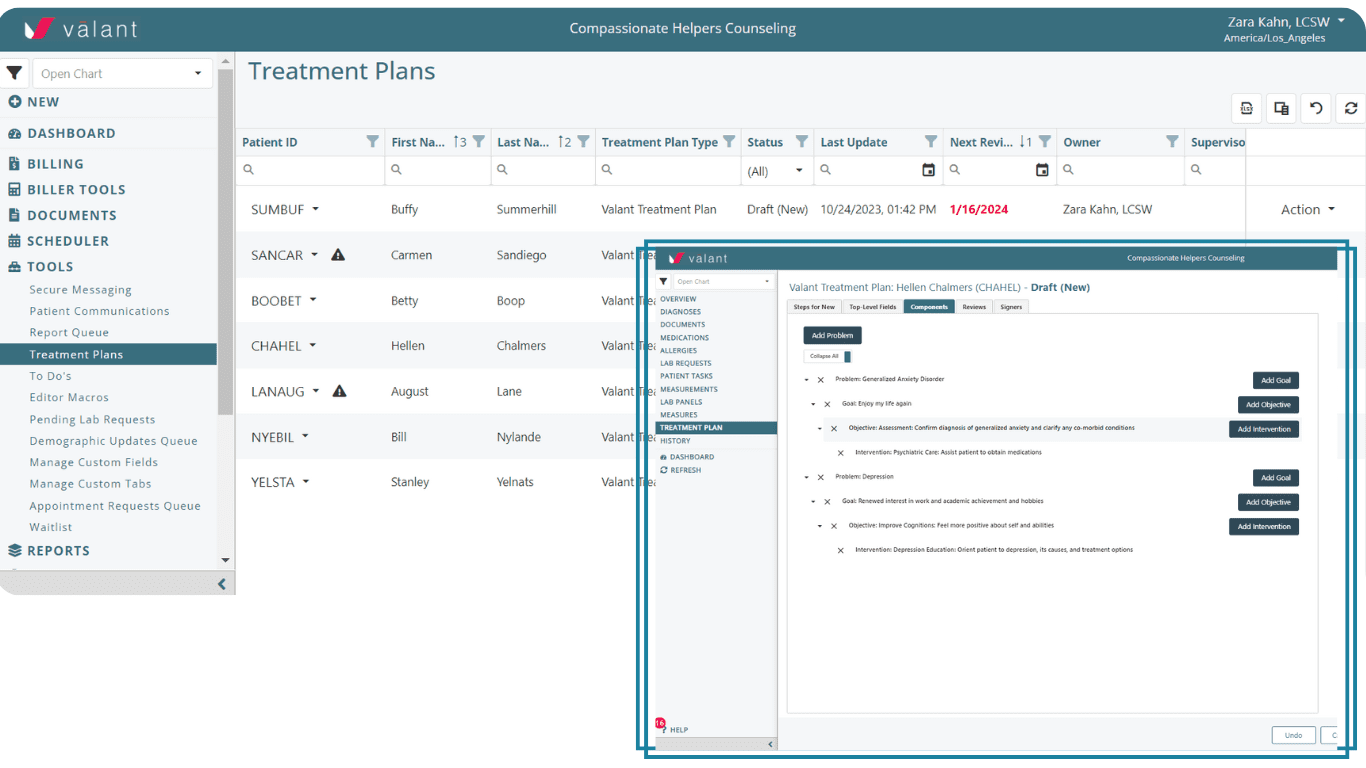
Elevate patient care and ensure compliant documentation with collaborative treatment planning. Build behavioral health treatment plans faster with templates, evidence-based content, progress tracking, and flexible workflows designed for outpatient, telehealth, and IOP/PHP care.
Treatment Planning Features That Grow With You
Build treatment plans more efficiently with flexible templates, evidence-based content, and workflows that help your clinicians move from diagnosis and intake information to clear, individualized plans, keeping sessions moving and not slowing down your processes.
Evidence-based Content Libraries
Pass audits with ease by customizing your review cycles and automated reminders for efficient and compliant plan management.
32 Integrated Wiley PracticePlanners
Support your niche specializations and patient populations by accessing treatment planning content from industry-leading experts for both outpatient and IOP/PHP.
Treatment Plan Templates
Meet the unique needs of your payers and treatment modalities by configuring multiple treatment plan templates for outpatient and IOP/PHP.
Automated Review Cycles & Reminders
Pass audits with ease by customizing your review cycles and automated reminders for efficient and compliant plan management.
Progress Updates from Clinical Notes
Keep the clinical flow going. Make seamless updates to a patient’s treatment plan progress directly from session notes.
Supervisor Collaboration
Promote clinical development by reviewing, editing, and providing feedback on supervisee treatment plans within the secure and collaborative platform.
Custom Practice and Provider Library
Create and manage your own practice library of treatment plan content, and empower your clinicians to build their own specialized libraries.
Treatment Planning for Busy Clinicians and Growing Rosters
Juggling treatment plans and patient care doesn’t have to be a struggle. With a clear, comprehensive overview of all treatment plans at your practice, you can monitor review cycles, track signing statuses, see which patients are in need of a plan, and reassign plan ownership whenever needed.
Gain a panoramic view of your clinical activity and ensure timely reviews, seamless collaboration, and exceptional patient care with ease. Standardize treatment planning across your practice while still giving clinicians the flexibility to tailor plans to each patient, diagnosis, and treatment approach.
Build Better Treatment Plans Faster
Creating strong treatment plans shouldn’t slow down care delivery. With configurable templates, built-in content libraries, and evidence-based planning tools, your clinicians can spend less time starting from scratch and more time building plans that are personalized, actionable, and easier to maintain over time.
Whether your team is working from intake information, diagnoses, or ongoing clinical notes, the right workflow helps turn treatment planning into a more natural part of care instead of an administrative hurdle.
Treatment Planning That Works for Virtual Care
Treatment planning should support virtual care without disrupting the flow of the session. With structured templates, progress updates tied to clinical notes, and content your clinicians can adapt quickly, it becomes easier to build and update treatment plans in ways that support both telehealth workflows and documentation requirements.
The goal is not to make treatment planning feel scripted. It’s to give your clinicians a clear structure they can use flexibly, so virtual visits still feel personal, collaborative, and clinically grounded.
Treatment Planning
Get Paid Your Worth: Avoid These 5 Treatment Planning Pitfalls
Behavioral health practices deserve fair compensation for the vital services you provide. However, securing insurance reimbursements can feel like an uphill battle.
Don’t let common treatment planning errors jeopardize your revenue. Learn about five small but costly mistakes and discover how you can avoid them with the right system in place.
Elevate Your Treatment Plans with Wiley’s Evidence-Based Content
Create audit-proof, action-oriented treatment plans with Wiley’s extensive library of 32 specialized PracticePlanners built into Valant’s Treatment Plan.
Get thousands of evidence-based problems, goals, objectives, and interventions to develop personalized plans for every patient. Support niche and neurodiverse patient populations and treatment specializations with the depth and flexibility of Wiley’s clinical content.
Click below for a full chart of Wiley PracticePlanners integrated with Valant. Use Wiley’s content as a starting point, then tailor goals, objectives, and interventions to each patient’s diagnosis, modality, and clinical needs.
Treatment Planning Built for IOP/PHP
IOP/PHP requires flexible and evidence-based treatment planning. With Valant, you can create treatment plan templates tailored to different program types, whether intensive outpatient (IOP) or partial hospitalization (PHP).
Clinicians can also leverage Wiley’s 32 integrated PracticePlanners, offering thousands of problems, goals, objectives, and interventions to support structured, personalized care. The result: plans that meet payer requirements, guide clinical progress, and reflect the unique needs of your IOP/PHP patients.
Why It Matters for Your Practice:
- Configure templates for specific IOP/PHP
- Ensure compliance with payer and regulatory requirements
- Access 32 Wiley PracticePlanners for evidence-based structure
- Build personalized, goal-oriented plans for IOP/PHP patients

Track Your Treatment Progress and Drive Positive Outcomes
Effective treatment planning is a cornerstone of successful behavioral health services. But delivering exceptional patient care while meeting the demands of payers and regulatory agencies can feel overwhelming.
By seamlessly tracking both clinical documentation and patient progress toward better outcomes, you provide the evidence needed to receive reimbursement for your services, which fosters growth for your practice.
Pass Treatment Plan Audits with Ease
Ensure your practice is always audit-ready. Configure treatment plan templates with built-in guardrails to feature data fields and measurable goals required by your most complex payer groups. Pull in extensive content libraries to build comprehensive treatment plans that pass even the toughest documentation audits.
Reduce Mental Load with Expansive Content Libraries
Develop individualized, actionable treatment plans without starting from scratch.
With extensive pre-built treatment plan content, including a built-in evidence-based library, Wiley PracticePlanners, custom practice libraries, and provider-specific libraries, you reduce cognitive load and speed your documentation process while delivering quality care.
Get Mental Health Treatment Plan Software That Grows With You
Making do with treatment plan features built for other medical specialties leaves you with extra manual work and barriers to growing your practice.
Gain the flexible, scalable tools you need to evolve with the growing needs of your practice and your payers.
Confidently navigate your treatment planning with built-in guardrails to ensure compliant, comprehensive documentation every time.
Frequently Asked Questions About Treatment Planning
What’s the easiest way to build a treatment plan during a telehealth visit without slowing down the session?
The easiest approach is to give clinicians a clear structure they can work from without having to start from scratch. Templates, evidence-based content, and note-connected workflows can make treatment planning feel more manageable during virtual care while preserving the focus on the patient.
How do I create a treatment plan that works for virtual care and still meets documentation requirements?
Start with a workflow that supports both flexibility and consistency. Configurable templates, measurable goals, required fields, and review-cycle reminders help your team build plans that work for telehealth while still supporting documentation and payer expectations.
How do I keep treatment planning from feeling robotic on video visits?
Give clinicians structure, not scripts. When they start with useful templates and adaptable content, they spend less energy building the framework and more energy personalizing the plan with the patient.
Do you have a treatment plan library I can customize by diagnosis and modality?
Yes. The page already highlights evidence-based content libraries, integrated Wiley PracticePlanners, configurable templates, and custom practice and provider libraries that support a wide range of diagnoses, modalities, and patient populations.
What’s the difference between treatment plan goals, objectives, and interventions?
Goals define the broader outcomes a patient is working toward. Objectives break those goals into measurable steps. Interventions are the actions or strategies used to support progress. Clear treatment planning helps clinicians connect all three in a way that is meaningful for care and documentation.
Can I build treatment plans quickly from intake information and diagnoses?
Yes. Templates, evidence-based libraries, and structured planning tools help clinicians move more efficiently from intake findings and diagnoses into personalized treatment plans.
How do I standardize treatment plans across clinicians but still allow flexibility?
A strong setup gives your practice shared templates, review workflows, and content libraries for consistency, while still allowing each clinician to personalize plans based on the patient, modality, and stage of care.
What’s the best way to train clinicians on treatment planning inside the EHR?
Training becomes easier when clinicians work from shared templates, built-in libraries, and supervisor-guided review. A more consistent treatment-planning framework gives supervisors and new clinicians a stronger foundation to work from.
See Other Ways Valant Can Improve Clinical Care
What They’re Saying
Related Resources
How to Run a Successful Group Therapy Session
Ready To Put Growth Into Practice?
Treatment Planning