

Creating effective treatment plans is essential in behavioral health. They offer a structured roadmap for both practitioners and clients, ensuring everyone is on the same page.
A comprehensive treatment plan template tailored for behavioral health promotes standardized and evidence-based care, supporting the likelihood that practitioners follow best practices while addressing the unique needs of individual clients. This fosters a collaborative and goal-oriented approach to mental health treatment.
A behavioral health treatment plan template gives clinicians a repeatable structure for documenting client needs, diagnoses, goals, measurable objectives, interventions, progress, and crisis planning. The template creates consistency, but every completed treatment plan should still be individualized for the client and updated as care progresses.
Treatment plan templates support in-person, telehealth, and hybrid care. When they’re built into an EHR, clinicians can create, review, update, and securely manage treatment plans without moving between disconnected documents or systems.
The Importance of Effective Treatment Planning
Seeing a behavioral health treatment plan sample may help patients better understand and engage in their care, providing them with clarity on the goals, strategies, and collaborative efforts involved in their treatment. This transparency builds trust and encourages participation.
A clear framework enriches patient care by offering opportunities for goal setting and progress tracking. With the structure and clarity they provide, treatment plans guide the way to positive outcomes.
They are living documents that evolve with a client’s progress and changing needs, ensuring interventions remain relevant and effective. In addition, they can improve communication and collaboration among a client’s care team.
A treatment plan is different from a diagnosis. The diagnosis identifies the condition, symptoms, or clinical concerns being addressed, while the treatment plan explains what the clinician and client will work toward, which interventions will be used, and how progress will be measured.
How to Write a Behavioral Health Treatment Plan Using a Template
A well-structured behavioral health treatment plan template is essential for ensuring consistency and promoting collaboration. A treatment plan facilitates transparent communication and measurable progress tracking for both clinicians and clients.
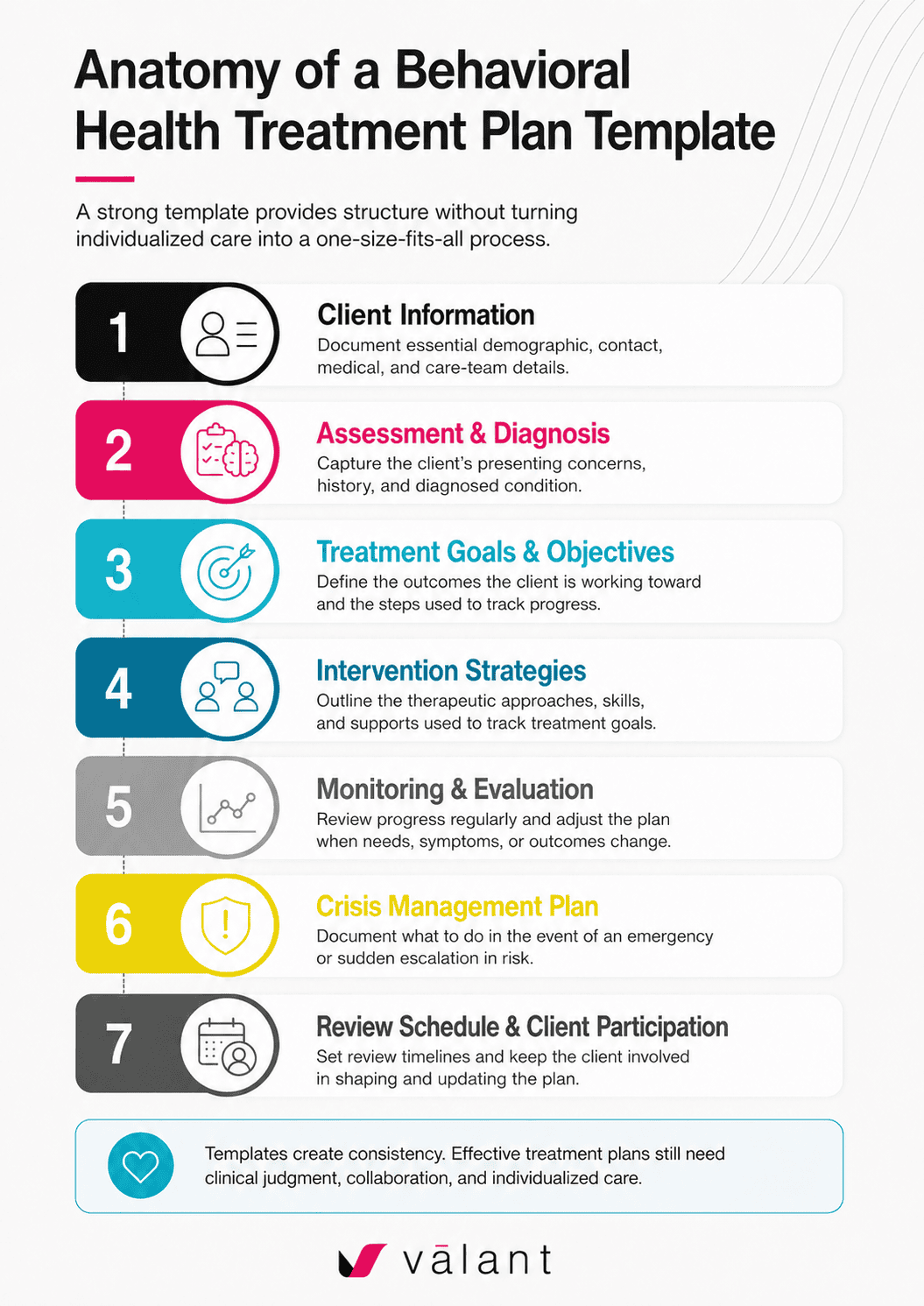
When it comes to crafting a treatment plan, there are seven important components to include. Don’t forget that any template is a starting point that should be tailored to each individual client’s unique needs.
1. Client Information
Gather essential details about the client, including personal information, demographics, relevant medical history, and information about their care team.
For telehealth clients, the workflow may also need to capture information required by the practice for virtual care, such as the client’s preferred contact method, emergency contact info, and relevant telehealth consent documentation.
2. Assessment and Diagnosis
Conduct a thorough assessment to understand the client’s needs and clearly state the diagnosed condition. For behavioral health treatment plan templates, specificity is key. Effective treatment requires understanding the unique needs of each client.
Assessment findings and diagnoses should inform the treatment plan without making it generic. Clients with the same diagnosis may have different priorities, strengths, barriers, and treatment goals.
3. Treatment Goals and Objectives
Define clear and measurable goals for the client to achieve during the course of treatment. Objectives should be specific, measurable, achievable, relevant, and time-bound (SMART).
Goals describe the broader change the client wants to achieve, while objectives break that goal into smaller, observable steps. This guide to mental health treatment plan goals and objectives offers additional examples for making plans specific and measurable.
4. Intervention Strategies
Outline the therapeutic interventions and strategies that’ll be used to reach the established goals. This may include counseling techniques, psychoeducation, and other therapeutic modalities. The interventions can be shaped by the nature of the problem, the willingness and ability of the client, and more.
Each intervention should connect clearly to a goal or objective. Clinicians should consider the client’s diagnosis, symptoms, preferences, strengths, culture, treatment setting, technology access, and response to care when choosing interventions.
For telehealth treatment plans, consider whether an intervention can be delivered effectively in a virtual session and practiced safely between appointments.
5. Monitoring and Evaluation
Establish a system for monitoring progress and periodically evaluating the effectiveness of the treatment plan. This ensures that adjustments can be made as needed.
Treatment plans should be reviewed regularly and updated when the client’s symptoms, goals, diagnosis, level of care, or response to an intervention changes. Formal review schedules may also depend on payer requirements, program standards, practice policies, and applicable regulations.
For virtual care, clinicians may collect assessments or client-reported outcomes through a secure portal before the appointment, review progress during the telehealth session, and document updates in the same treatment-planning workflow.
6. Crisis Management Plan
Develop a clear crisis management plan that outlines steps to be taken in the event of an emergency.
For telehealth clients, the crisis plan should also reflect the practice’s virtual-care procedures. That may include confirming how the clinician will respond if a client experiences an emergency while joining from another location and documenting the appropriate emergency contacts and resources.
7. Review Schedule and Client Participation
Document when the treatment plan should be formally reviewed and how the client will participate in those reviews. A treatment plan should be a collaborative clinical tool, not simply a form completed for documentation purposes.
Explain the plan in simple language so the client understands what they’re working toward, what the clinician will do, and how both parties will know whether treatment is helping.
Managing Treatment Plans for Telehealth and Virtual Care
The clinical components of a treatment plan don’t fundamentally change when care moves online, but the workflow may require further attention. Clinicians still need to collaborate with clients, select appropriate interventions, monitor outcomes, document changes, and protect treatment information.
During a telehealth appointment, the clinician can review the treatment plan with the client on screen, discuss progress toward each objective, and update the plan while the conversation is still fresh. This keeps virtual treatment planning collaborative rather than turning it into a separate documentation task after the session.
When sharing a treatment plan with a client, use a secure patient portal or another practice-approved, protected workflow instead of relying on unstructured email attachments. The client should be able to review the plan without exposing sensitive clinical information or creating disconnected copies that may become outdated.
Practices should align their telehealth, consent, privacy, and document-sharing processes with applicable requirements and organizational policies.
What Treatment Plan Templates Does a Practice Need?
The right template library depends on the practice’s specialties, services, client population, and documentation requirements. Rather than creating one rigid template for every situation, practices may benefit from a core structure that can be adapted to several types of care.
Common treatment plan template needs may include:
- Individual outpatient therapy
- Psychiatric or medication-management services
- Couples or family therapy
- Group therapy
- Telehealth and hybrid care
- Higher-acuity programs, such as IOP or PHP
- Specialty services or diagnosis-specific workflows
- Discharge, transition, or continuing-care planning
A group therapy treatment plan template requires particular care. The group may have shared themes or program objectives, but each client should still have an individualized treatment plan that reflects their own diagnosis, goals, interventions, participation, and progress. A group-level outline shouldn’t replace client-specific clinical documentation.
How to Standardize Treatment Plans Across Clinicians
Standardization doesn’t mean making every treatment plan identical. It means giving clinicians a consistent framework for documenting required information while preserving the flexibility to individualize goals, objectives, interventions, and language.
Practices can improve consistency by using:
- Shared treatment plan templates
- Standard definitions for goals and measurable objectives
- Required fields for core clinical information
- Configurable intervention and objective libraries
- Consistent review schedules and reminders
- Supervisory review processes where appropriate
- One connected location for plans, notes, assessments, and updates
These shared workflows are particularly valuable for group practices, where documentation may otherwise vary significantly between clinicians. Standardization can improve consistency, make training easier, and reduce the risk of missing important information without limiting clinical judgment.
Reviewing common treatment plan mistakes to avoid also helps practices identify where templates and workflows need clearer guidance.
Getting Familiar with Treatment Plan Templates
We’ve created this treatment plan template to give behavioral health professionals like you an example of the inputs and outputs of treatment planning. Get your copy to develop familiarity with the concept, or compare it to your current treatment plan.
Consider that while using a standalone treatment plan template such as this one can provide value, you may find it easier to use your EHR’s treatment planning capabilities.
With an EHR-integrated treatment plan template, providers can efficiently input and track essential information. Client details, diagnoses, treatment goals, progress monitoring, and crisis management will be stored within the EHR. Your EHR may even offer a library of templates, so you can tailor each client’s treatment plan to their specific needs.
Fostering Positive Outcomes
Effective treatment plans are a pivotal part of achieving positive outcomes. By using a comprehensive treatment plan template, mental health professionals can ensure a systematic approach to patient care.
Having structured tools like a treatment plan template contributes to the success of therapeutic interventions, and even more so if the template is integrated within your EHR. The result is a more efficient clinical workflow and a reliable path to improved patient outcomes.
The goal isn’t simply to complete a treatment plan. It’s to create a useful, collaborative document that helps clinicians and clients understand the direction of care, monitor progress, and adjust treatment when needs change.
Valant’s behavioral health treatment-planning tools include built-in templates and customizable options that help practices create a more consistent process while preserving clinician flexibility. Practices can use structured content as a starting point, adapt templates to their workflows, and keep treatment plans connected to the broader clinical record.
Treatment Plan Template
Please check your email for your treatment plan template download.
Frequently Asked Questions About Treatment Plan Templates
What should a behavioral health treatment plan template include?
A behavioral health treatment plan template should include client information, assessment findings, diagnosis, goals, measurable objectives, interventions, progress-monitoring criteria, review dates, and crisis-planning information. The completed plan should also reflect client preferences, strengths, cultural considerations, and the specific setting in which care is delivered.
How do you write a behavioral health treatment plan?
Start by using assessment and diagnosis information to identify the client’s needs, then create meaningful goals and measurable objectives. Select interventions that connect to those objectives, establish a timeline for reviewing progress, involve the client in the process, and update the plan as care evolves.
How do you manage treatment plans for telehealth clients?
Use a connected workflow that allows clinicians to review, update, and document the treatment plan during or shortly after a secure telehealth session. The plan should account for virtual care needs such as tech access, telehealth consent, communication preferences, crisis procedures, and interventions that can be delivered effectively online.
How can treatment plans be shared with clients securely?
Treatment plans should be shared through a secure patient portal or another protected workflow approved by the practice. Avoid sending sensitive treatment information through unstructured channels, and make sure the version available to the client reflects the current plan.
What should a group therapy treatment plan template include?
A group therapy treatment plan template should connect the client’s individual needs and goals to the interventions and objectives addressed through group care. Although the group may share an overall therapeutic focus, every participant should have an individualized plan and client-specific documentation.
How can a practice standardize treatment plans across clinicians?
Use shared templates, required clinical fields, consistent goal and objective structures, intervention libraries, and defined review schedules. These tools provide a common framework while still allowing each clinician to personalize the plan for the client.
What treatment plan templates does a behavioral health practice need?
The right templates depend on the practice’s services, specialties, and levels of care. Common needs include templates for individual therapy, psychiatry, group therapy, couples or family care, telehealth, IOP or PHP services, and discharge or continuing-care planning.
What treatment plan templates does Valant offer?
Valant provides built-in behavioral health treatment-planning templates and customizable options that practices can adapt to their clinical workflows. These tools help clinicians structure goals, objectives, interventions, progress monitoring, and plan reviews while keeping the information connected to the client’s broader record.
What should I look for in an EHR with customizable treatment plan templates?
Look for an EHR that combines reusable structure with enough flexibility to support individualized care. Important capabilities include configurable templates, measurable goals and objectives, intervention libraries, review reminders, progress tracking, secure client access, and support for in-person and telehealth workflows.