

A guide for behavioral health clinics entering the world of IOP/PHP institutional billing.
When behavioral health clinics first begin exploring the idea of expanding into higher-acuity services—programs like Intensive Outpatient (IOP) or Partial Hospitalization (PHP)—the conversations usually center around patient need. Your team might talk about how many clients require more structure than a weekly therapy appointment can provide, or how often step-down care becomes unavailable in your community, or how your clinicians feel compelled to offer a more robust treatment path.
You begin imagining what that program might look like. Maybe it starts with a few therapy groups in the morning, a skills session in the afternoon, medication check-ins, supervised breaks, and a predictable weekly rhythm. Before long, the program schedule starts to take shape. Clinicians are excited. Community partners are asking about referrals. The vision becomes real.
Then the billing team enters the scene.
They glance at the schedule, look at the structure, and almost immediately recognize what’s ahead. They know that although the care will take place in an outpatient setting, the billing will not follow the outpatient rules your practice has known for years. And this is often when someone says the phrase that every clinic expanding into IOP/PHP becomes deeply familiar with:
“This has to be billed on the 837I.”
It’s a moment that tends to change the entire direction of the conversation. Because the 837I isn’t just a different claim form. It signals your clinic’s transformation—from a traditional outpatient practice to something closer to a facility delivering structured, multidisciplinary care. Even though you aren’t running a hospital, you are operating a program that functions with more intensity, more coordination, and more oversight than anything standard outpatient billing was designed to capture.
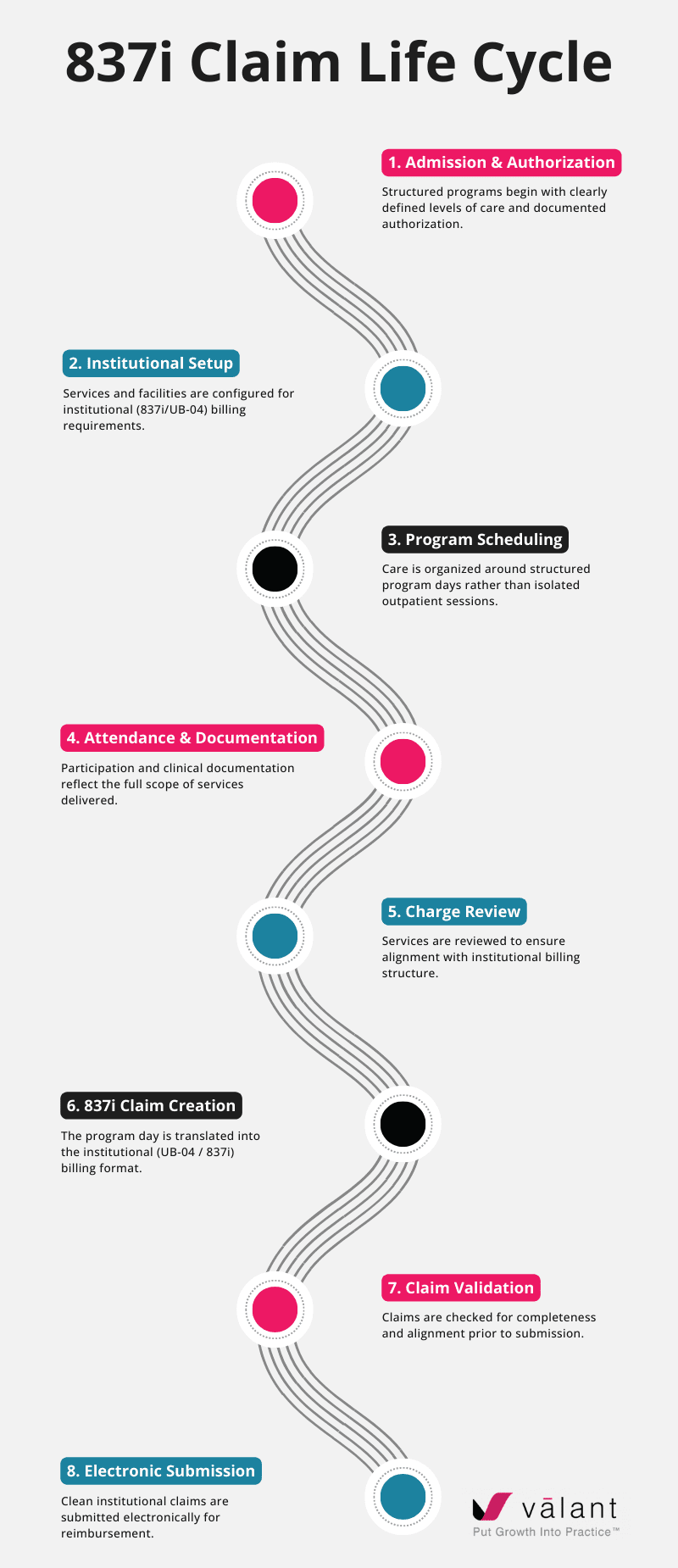
In the outpatient world, everything is relatively straightforward. A client sees a clinician for a defined service. That service is tied to a CPT code. The clinician documents the encounter, and billing submits a clean, simple 837P claim. It’s a neat sequence of events: one provider, one client, one session, one claim. That’s the billing language most clinics speak fluently.
But the moment you step into IOP/PHP, something fundamental shifts. Instead of documenting isolated appointments, your team is documenting entire program days. Care becomes multidisciplinary, woven across multiple hours, clinicians, encounters, and therapeutic purposes. A client isn’t attending “a session.” They’re participating in an orchestrated set of services that unfold through the day, sometimes five days a week. All of this is happening in an outpatient environment, yet the structure looks very much like facility-level care.
This is where the 837I comes in—not as a bureaucratic burden, but as the payer’s way of understanding the full scope of what your clinic delivered. The 837I is the electronic version of the UB-04, the longstanding institutional billing form used by hospitals and structured care programs. Where the 837P focuses on a single clinical encounter, the 837I paints a picture of the entire day. It captures not only that care occurred, but how it occurred, why it occurred, and what level of intensity was necessary. The claim tells the story of the program in a way that the outpatient claim types simply cannot.
This narrative-heavy nature of the 837I is what makes it feel so different to clinics seeing it for the first time. Instead of asking, “What happened in this appointment?” institutional billing asks, “What happened in this program?” Instead of asking, “What did the clinician do?” it asks, “What services did the facility deliver?” Instead of aligning reimbursement with minutes or sessions, it aligns it with structured program days—often bundling multiple therapeutic contacts into a single reimbursable unit. It’s a shift not only in billing, but in mindset.
This shift can catch clinics off guard. Leadership may imagine that launching IOP/PHP is mostly a clinical build-out, and the billing will simply follow. But billing for higher-acuity outpatient programs isn’t a clerical detail—it’s an operational engine. An IOP or PHP can have extraordinary clinical outcomes and still fail financially if the billing infrastructure is built on outpatient assumptions. Many clinics only realize this when the first batch of claims is denied—not because care wasn’t delivered, but because the story wasn’t told in the language payers require.
This is often the moment when teams recognize that the 837I is not just a claim type. It is the blueprint of the entire program. It reveals whether your documentation aligns with your schedule, whether your schedule aligns with your benefit checks, whether your utilization review aligns with your medical necessity requirements, and whether your internal workflows reflect the expectations of facility-level care. When the 837I is easy, the program tends to run smoothly. When it’s difficult, the same issues show up across scheduling, notes, staffing, and clinical workflow.
But the good news—the part no one tells you early enough—is that once a clinic understands the rhythm of institutional billing, everything becomes clearer. Suddenly, you’re no longer trying to squeeze a structured program into an outpatient billing framework. Instead, you’re building a program that respects its own operational truth. And with the right processes, staffing, and technology, the 837I becomes not a source of anxiety but a source of stability. Denials drop. Revenue becomes predictable. Program days align neatly with payer expectations. Utilization review conversations feel less adversarial and more collaborative. Clinics move from “figuring it out” to “running a real program.”
Most importantly, mastering 837I allows clinics to scale. A single IOP group may be manageable through trial and error, but sustained growth—adding tracks, expanding hours, opening new locations—requires a billing model that supports the clinical ambition behind it. Institutional billing is the framework that makes this possible.
The rise of IOP and PHP programs across the country reflects a larger shift in behavioral health: the recognition that many clients need more than a weekly session but don’t require hospitalization. These programs fill a gap the industry has struggled with for decades. The 837I is simply the tool that ensures clinics are reimbursed fairly for delivering that care. Once you understand it—once you see how it fits into the narrative of your program—it becomes far less intimidating, and far more empowering.
The truth is that the 837I is just a new way of telling the story of patient care. It’s a more comprehensive story, yes. A more detailed one. But it is still just a story of how your team shows up for patients in moments when they need you most. The billing structure is there to reflect the reality of the care you’re providing: structured, intensive, team-based, and essential.
And once your clinic begins to speak this new language fluently, the program you’ve built stops feeling like an experiment and starts feeling like the next chapter of your organization’s growth.




The Best Practice Guide for IOP/PHP
Gain access to The Best Practice Guide for Intensive Outpatient Programs and Partial Hospitalization Programs: