





A Behavioral Health EHR

For Intensive Outpatient and Partial Hospitalization Programs

Run successful IOP and PHP programs with a connected EHR that supports group scheduling, attendance tracking, institutional billing, and multi-level clinical documentation—without relying on spreadsheets or workarounds.

Explore IOP/PHP Features

IOP/PHP programs require more than a standard outpatient EHR. These features are purpose-built to support group-based care, track outcomes and utilization, and help teams coordinate staffing, census, and capacity across multiple tracks.

Group Scheduling & Attendance

Helps teams manage complex daily schedules, recurring group sessions, and multi-clinician coverage while maintaining accurate attendance records that support IOP and PHP billing workflows.

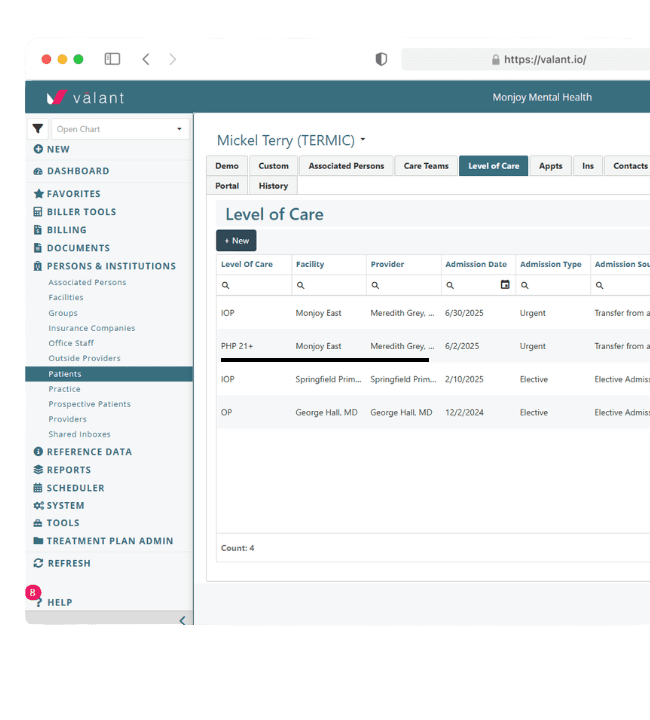
Level of Care (LOC) Tracking

Supports documentation for level of care tracking and changes, helping teams stay prepared for audits and payer reviews.

Utilization Review Workflows

Centralizes authorized hours, attendance, and utilization tracking to help reduce disruptions to care delivery and reimbursement.

Institutional Billing

Built to support IOP and PHP institutional billing requirements, including daily rates, revenue codes, bundled services, and 837i UB 04 submissions.

All In One EHR

Eliminates reentry, syncs records, and improves visibility.

Patient Adherence Tracking

Identifies early signs of patient disengagement, allowing staff to intervene and improve retention across IOP and PHP programs.

Role Based Training

Ramp quickly and ensure consistent workflows with onboarding tailored to user roles.

Discharge & Transition Planning

Transition patient care smoothly with structured discharges and clear documentation.

How Valant Solves Common Provider Challenges

COMMON CHALLENGES

VALANT SOLUTIONS

Manual documentation wastes staff time

Structured templates reduce rework so staff spend more time with patients, not paperwork.

Compliance risk during audits

Level of Care and Utilization Review tools ensure documentation meets payer and state requirements with confidence.

Complex billing leads to denials

Built in claim rules simplify institutional billing, reduces denials, and speeds reimbursement.

Patients disengage and stop showing up

Attendance tracking enables early intervention and helps keep patients engaged in care.

Group management overwhelms staff

Simplified group scheduling and attendance tools reduce admin work and free up staff time.
IOP/PHP Software

Speed Your Process With Efficient Workflows

Running an IOP/PHP program involves managing scheduling, attendance, authorizations, billing, and documentation, all while delivering care. Valant brings these tasks into one connected system, reducing administrative burden and giving staff the time and focus to be fully present with patients. By bringing these workflows into a single, intensive outpatient program EHR, teams reduce administrative burden, improve coordination across clinicians, and maintain consistency as programs grow.

Focus Your Efforts With a Compliant Solution

Audits do not have to cause stress. Valant embeds compliance support into everyday workflows by helping teams track authorizations, standardize documentation, and reduce preventable claims errors. Providers can approach audits with more confidence, knowing key requirements are addressed and records are easier to retrieve. This includes commonly required documentation and reporting to support level of care changes, utilization reviews, and payer or state audits.

Track Progress and Grow With Confidence

IOP and PHP patients are at a vulnerable stage in care, which makes consistency and engagement critical. Valant helps teams track group attendance, monitor engagement, and connect clinical notes across levels of care, supporting continuity across IOP and PHP. With integrated tracking for attendance, engagement, and utilization, teams can spot participation trends earlier, support utilization management, and back payer conversations with clearer documentation—all while maintaining quality and consistency as programs scale.

Get A Closer Look of IOP/PHP Workflows

IOP PHP Software

FAQs

What is IOP/PHP?

IOP and PHP are structured care programs that serve as a critical bridge between outpatient therapy and inpatient hospitalization.

What are the required hours for Intensive Outpatient Programs?

About 3 hours per day, 3 to 5 days per week, usually lasting 6 to 12 weeks.

What are the required hours for Partial Hospitalization Programs?

5 to 6 hours per day, 5 days per week, usually lasting 2 to 6 weeks.

What should I look for in IOP/PHP software?

Look for software that supports group scheduling, attendance tracking, institutional billing workflows, utilization review support, and documentation built for intensive outpatient and partial hospitalization programs.

How is an IOP/PHP EHR different from a standard outpatient EHR?

IOP and PHP-ready EHRs support group-based care, multi-level programs, attendance-driven billing workflows, and utilization tracking. These are capabilities that most standard outpatient EHRs are not designed to handle well.

How can IOP/PHP software help reduce billing errors and denials?

Accurate attendance tracking, structured documentation, and institutional billing workflows can help reduce common errors by keeping claims aligned with authorizations and payer requirements.

How do programs track attendance and utilization effectively?

Centralized group attendance, authorization tracking, and utilization review workflows help teams stay aligned on requirements, reduce manual work, and stay better prepared for audits and payer reviews.

How can software improve patient retention in IOP and PHP programs?

Attendance and adherence tracking can help teams spot early signs of disengagement, so staff can intervene sooner and support continued participation.

What They’re Saying

Progress notes are easy to use and treatment plan suggestions make this process easy. Informed Consent, Diagnosis page, Mental Status Exam and many other suggested or necessary documents are at your fingertips.

Ann S.,Owner

The software facilitates efficient screening, scheduling, initial evaluation, and ongoing treatment by allowing the patient to interact directly with administrative personnel, clinicians, and assessment instruments.

David B.,Owner

It is intuitive and easy for our counselors to use… organization of patient charts and history is outstanding.

Candyce N.,Administrator

Related Resources

Portrait of a successful female psychologist sitting in arm chair with laptop in front. Happy mental health professional.BlogEHR TechnologyIOP/PHP
February 9, 2026

Don’t Use the Wrong IOP/PHP EHR: A Real-World Checklist for Comparing Solutions

Choosing an EHR is one of the most consequential decisions an IOP or PHP program can make. The right system becomes the backbone of clinical care, compliance, and revenue. And the wrong one? It quietly creates friction everywhere—manual workarounds, billing…

Shot of a group of businesspeople sitting in a circle and having a meeting in a modern officeBlogIOP/PHP
February 3, 2026

No-Show Proof Your IOP: Smarter Group Scheduling and Attendance Tracking That Protects Continuity of Care

For Intensive Outpatient (IOP) and Partial Hospitalization Programs (PHP), attendance is more than an operational metric—it’s a clinical signal. Missed sessions can indicate disengagement, emerging risk, or breakdowns in transitions between levels of care. And when attendance tracking lives in…
Everything You Need to Know About 837IBlogIOP/PHP
February 2, 2026

Everything You Need to Know About 837i

A guide for behavioral health clinics entering the world of IOP/PHP institutional billing. When behavioral health clinics first begin exploring the idea of expanding into higher-acuity services—programs like Intensive Outpatient (IOP) or Partial Hospitalization (PHP)—the conversations usually center around patient…

See How We Can Help Your Team Today

Or Contact Us to Speak with a Specialist