

Guidance for Sustainable Behavioral Health Practice Operations
Optimizing your practice operations starts with data. Analyze the insights you have to identify your inefficiencies.
For an established mental health practice, optimization is less about rebuilding your entire operation and more about finding the friction inside processes you already use. Look for tasks staff repeat manually, points where patients need extra assistance, information moving between disconnected systems, and workflows that become harder to manage as volume changes.
Use Your Patient Portal for Routine Self-Service
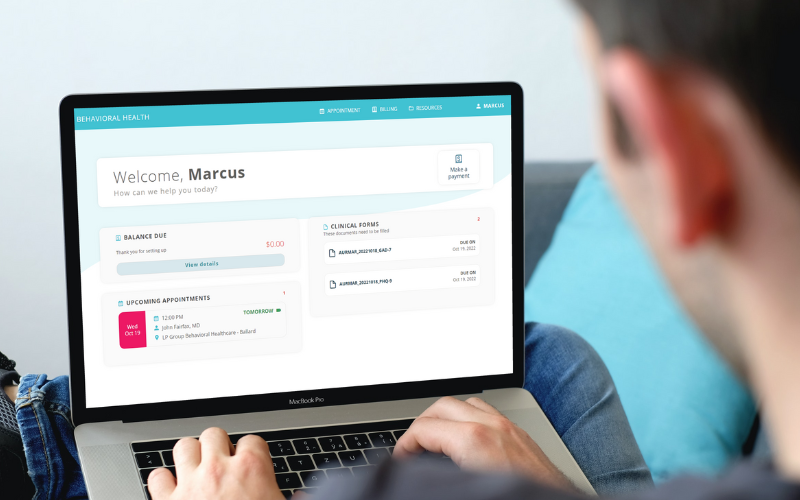
A patient portal can become the central point for many of the interactions that would otherwise turn into phone calls, emails, or manual follow-up. Giving patients a consistent place to complete routine tasks reduces unnecessary handoffs while making the experience easier to navigate.
Think about which interactions truly require staff involvement. Appointment-related information, forms, secure communication, telehealth access, payment tasks, and other routine actions may fit into a self-service workflow, leaving your team more time for questions that require judgment or conversation.
Portal adoption matters, too. Introduce the portal as part of your standard patient experience rather than treating it as an optional tool patients discover later. When staff consistently direct patients to the same process, self-service becomes part of how your practice operates.
Standardize the Work Your Team Repeats
As your practice becomes established, informal processes often become harder to maintain. A workflow that once lived in one person’s memory may now involve several clinicians, administrative staff members, billers, or locations.
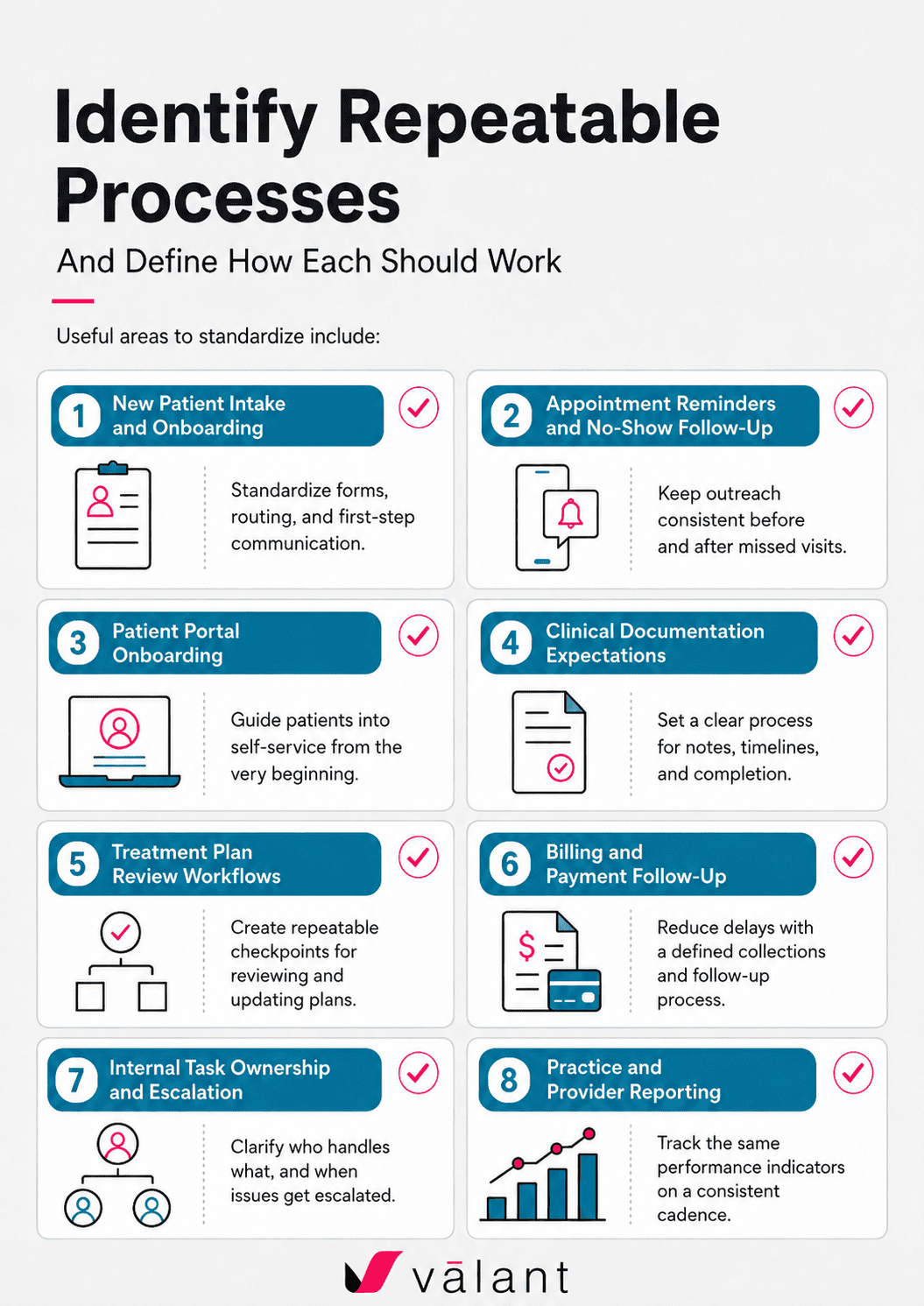
Identify repeatable processes and define how each should work. Useful areas to standardize include:
- New patient intake and onboarding
- Appointment reminders and no-show follow-up
- Patient portal onboarding
- Clinical documentation expectations
- Treatment plan review workflows
- Billing and payment follow-up
- Internal task ownership and escalation
- Practice and provider reporting
Standardization shouldn’t remove clinical flexibility. The goal is to make routine operational work predictable, so your team spends less time deciding how a process works and more time addressing situations that actually require individual attention.
Optimize for the Practice You Run Today
Practice structure also affects what sustainable operations look like. A solo provider may prioritize automation and simplicity, while a larger group may need stronger standardization, reporting, permissions, and coordination across teams.
Find Operational Guidance for Your Role
Different members of your practice experience operational friction in different ways. Use role-specific resources to focus on the workflows you manage most often.
Know Where You Are in the Practice Life Cycle
Maintaining an established practice is one stage of a longer operational journey. If you’re still building your foundation, revisit Starting Your New Practice.
If you’re learning how to make better use of your workflows and technology, explore Learning How to Grow Your Practice. When your priority shifts toward expanding capacity, providers, programs, or locations, continue to Growing Your Practice.
Your operational priorities should change as the practice changes. Reviewing your processes at each stage keeps systems created for yesterday’s practice from becoming barriers to tomorrow’s needs.
Maintaining Your Practice
Know What's Going On with 20 Practice KPIs
To find out what’s working and what could be better, the best practices monitor key performance indicators. Learn what KPIs you should track to measure progress, identify areas for improvement, and achieve your goals.
Maintaining Your Practice
Common Questions Asked by Others Like You
How can I improve patient engagement without adding more administrative work?
Automate routine engagement activities while keeping higher-value conversations personal. Appointment reminders, automatically delivered documents and outcome measures, portal access, secure messaging, and other repeatable communications can keep patients connected without asking staff to manage every interaction manually.
How can measurement-based care support sustainable practice operations?
Measurement-based care gives you structured information about patient progress that clinicians can use when evaluating treatment. Regular symptom measures can strengthen conversations with patients, inform treatment decisions, and make it easier to identify when someone may need additional support or a different approach.
How can I reduce claims denials and protect practice revenue?
Start by reducing preventable errors before a claim leaves your practice. Capture accurate patient information, confirm eligibility, keep documentation complete, and use connected billing workflows to reduce duplicate entry and surface issues before submission.
What reports should I monitor to keep my behavioral health practice healthy?
Focus on reports tied to decisions you need to make, including provider productivity, patient retention, outcomes, referral sources, aging balances, and other financial indicators relevant to your practice. Reviewing a consistent set of metrics over time gives you a clearer picture of where operations are strong and where changes may be needed.
How can I use a patient portal to streamline behavioral health practice operations?
Use your patient portal as a consistent destination for routine patient interactions instead of relying on separate calls, emails, and manual handoffs. A well-integrated portal can support self-service workflows and make it easier for patients to complete common tasks while reducing repetitive administrative work for your team.
Maintaining Your Practice