


As a behavioral health professional, the total amount of work you put into your practice goes well beyond one-to-one time spent with patients. For every billable hour, your practice must also account for the time spent on documentation, billing, and other processes that support the provision of care. It’s in these back-end administrative tasks where operational efficiency most clearly impacts your bandwidth as a provider.
An efficient private practice isn’t one where every minute is billable. It’s one where routine administrative work is predictable, repeatable, and supported by systems that keep staff from doing the same work twice. Intake moves forward without constant follow-up, documentation gets completed promptly, billing doesn’t depend on manual handoffs, patients can complete routine tasks themselves, and practice leaders have enough data to see where workflows are slowing down.
A Quiz for Behavioral Health Professionals
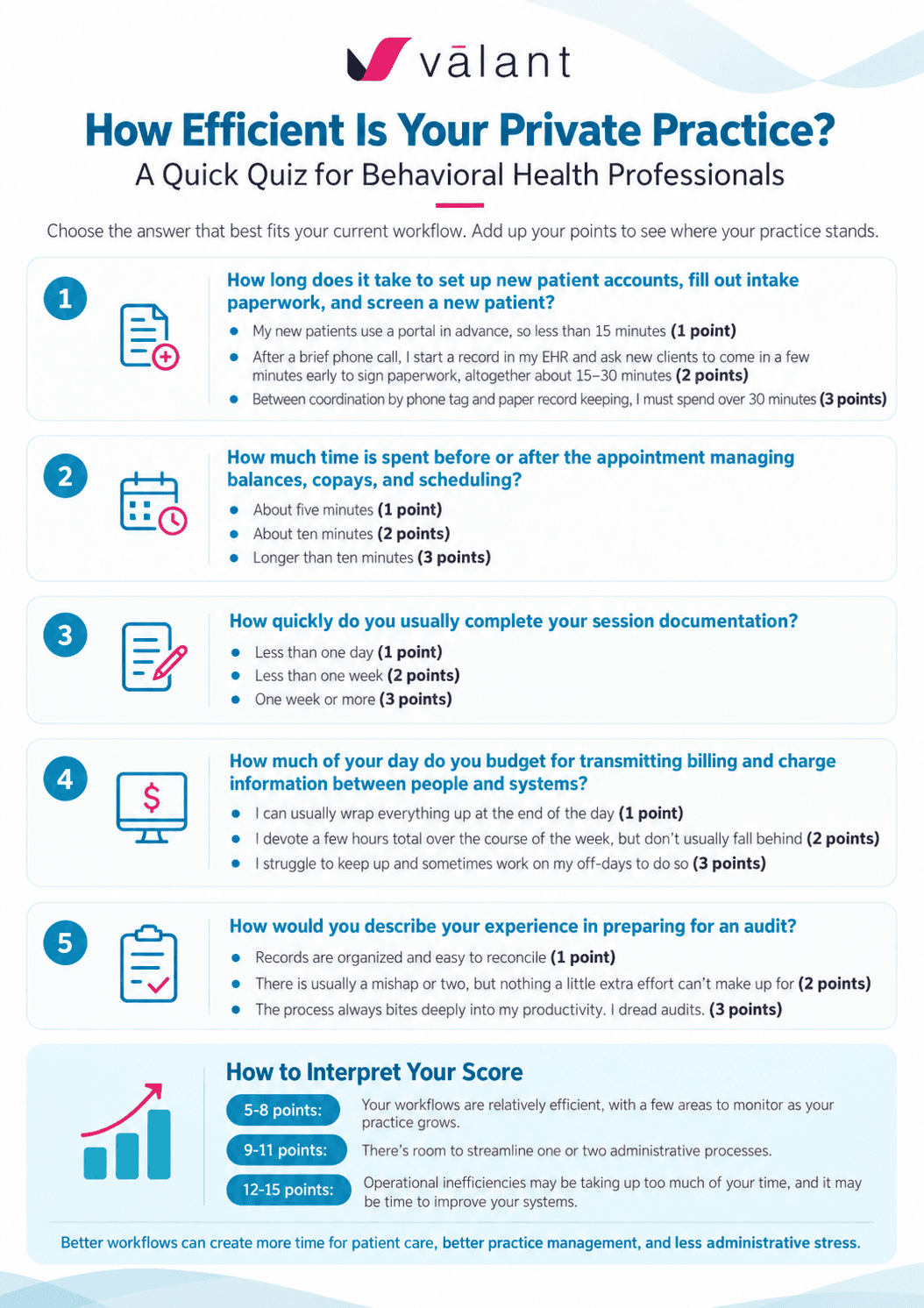
As the manager of a private practice, it’s in your best interest to understand how efficiently your practice operates. The following is a short introspective quiz designed to give practices like yours some perspective.
Quiz Instructions
Add up the point values associated with each TRUE response. Use your results as a starting point rather than a final grade. The goal is to identify where administrative friction is consuming time you could otherwise spend on patient care, practice management, or your life outside of work.
For a broader look at optimizing an established practice, explore Valant’s Maintaining Your Practice resources.
What Your Score Really Means
If your total score is 9 or higher, there’s room for improvement in your practice’s operational efficiency.
A higher score can point to one or more recurring problems:
- Too many manual intake steps
- Time-consuming patient communication
- Documentation backlogs
- Disconnected billing workflows
- Difficulty finding the information you need when preparing for an audit
Rather than trying to fix everything at once, identify the area creating the most repetitive work and start there. Even practices with lower scores should periodically reassess these workflows. A process that works well for one clinician or a smaller patient volume may become inefficient as the practice adds providers, patients, services, or payer relationships.
Where Private Practice Inefficiency Usually Shows Up
Operational inefficiency often hides in small tasks rather than one obvious problem. 10 minutes spent calling a patient about an incomplete form may not feel significant, but repeated across dozens of patients, those small interruptions consume hours every week.
Look for work that requires your team to repeatedly enter the same information, switch between systems, chase patients or providers for missing information, manually move data from one step to another, or stop what they’re doing to answer routine questions.
Common trouble spots include:
- New patient intake and onboarding
- Scheduling and appointment reminders
- Clinical documentation completion
- Patient balances and payment collection
- Insurance eligibility and claims administration
- Claim follow-up and denial management
- Patient communication
- Reporting and practice performance monitoring
These are also the workflows where a behavioral health-specific electronic health record (EHR) can provide the most leverage. Automation doesn’t remove the need for staff judgment. It removes repetitive steps, so your team can spend more time on work that needs it.
How EHR Automation Reduces Administrative Work
EHR automation reduces admin work by allowing predictable tasks to happen according to established workflows instead of requiring someone to initiate every step manually. Appointment reminders, intake processes, outcome measures, billing workflows, and reporting are all examples of work that may be streamlined through automation.
Start by looking for repetitive processes with clear rules. If staff routinely perform the same action after every appointment, every new patient request, or every completed form, ask whether your EHR can trigger or simplify that next step. Our article on EHR automation features that improve practice efficiency explores several of these opportunities in more detail.
The objective isn’t to automate every interaction. Patient care still depends on human judgment and communication. The strongest automation strategy handles routine administrative steps in the background while making exceptions and follow-up needs easier for your team to identify.
Reduce Time Spent on Billing and Claims Administration
Billing is one of the easiest places for administrative work to multiply. Your staff may need to confirm documentation, prepare claims, submit them, monitor status, correct errors, follow up on denials, post payments, and manage patient balances. When those steps happen across disconnected systems, every handoff creates another opportunity for manual work.
A more efficient workflow connects scheduling, documentation, and billing information so staff don’t have to recreate the encounter before a claim can move forward. Look for ways to reduce manual bill creation, identify missing information before submission, track claims in one place, and make outstanding balances easier to monitor.
Valant’s behavioral health billing software connects billing with the broader EHR workflow, including claims tracking and reporting. For practices managing insurance billing internally, the goal should be to spend less time assembling and locating information and more time addressing the claims that require attention.
Give Patients More Ways to Complete Routine Tasks Themselves
An effective patient portal should do more than display information. It should give patients a secure place to complete common tasks without requiring a phone call or separate exchange with your staff.
For a mental health practice, useful patient portal capabilities include:
- Completing intake forms and assessments
- Reviewing upcoming appointments
- Requesting or managing appointments
- Receiving and responding to secure messages
- Viewing statements and paying balances
- Updating payment information
- Accessing telehealth appointments
- Completing assigned outcome measures or other forms
The more consistently patients use these tools, the fewer routine transactions your staff has to mediate. Valant’s MYIO Patient Portal connects onboarding, payments, secure messaging, scheduling, telehealth, and other patient-facing workflows with the EHR.
Portal adoption matters just as much as portal functionality. Build portal onboarding into your standard new-patient process so patients know where to go for routine interactions from the beginning.
Track the Performance Indicators That Reveal Inefficiency
You can’t evaluate practice efficiency only by asking whether everyone feels busy. Track a focused set of performance indicators that show whether your clinical, administrative, and financial workflows are working as intended.
Depending on your practice goals, useful indicators may include:
- Provider productivity and utilization
- Appointment volume and no-show rates
- Patient retention
- Referral sources
- Documentation completion
- Outstanding patient and insurance balances
- Claims requiring follow-up
- Revenue and collection trends
- Patient outcomes
The right metrics depend on what you’re working to improve. If billing is the problem, start with aging balances, claim status, and collection patterns. If staff capacity is the issue, look at scheduling, provider productivity, documentation, and how much administrative work accompanies each patient interaction.
Our performance reporting tools include reporting across financial performance, aging balances, patient retention, referral sources, documentation status, and outcomes, giving practices a clearer view of where processes may need attention.
Efficiency Should Make Your Practice Easier to Run
Improving efficiency isn’t about squeezing more work into every hour. It’s about removing unnecessary work from the hour in the first place. When intake, documentation, billing, patient communication, and reporting work together, your practice is less dependent on manual follow-up and individual workarounds.
Start with the friction revealed by your quiz results. If intake consumes too much staff time, examine your onboarding and patient portal workflows.
If claims dominate your week, look at how scheduling, documentation, and billing connect. If you’re unsure where the problem is, use reporting to identify where delays and backlogs are accumulating.
Valant brings clinical care, practice management, billing, patient engagement, automation, and reporting together in an EHR made precisely for behavioral health. Instead of adding another tool to manage, you can use connected workflows to reduce repetitive administrative work and create more capacity for your patients and your practice.
Request a live demo to see how Valant can help you identify and streamline the workflows slowing your practice down.