



Insurance billing can look straightforward from a distance. A session happens, a claim goes out, and reimbursement comes back.
In practice, it rarely feels that clean.
For behavioral health practices, insurance billing depends on a chain of workflows that all need to stay aligned:
- Scheduling details affect the claim.
- Documentation supports coding.
- Billing staff need clear, timely information.
- Reporting needs to show what’s been submitted, what’s been paid, and what’s getting stuck.
When those pieces live in different systems, billing gets slower, errors become more likely, and staff spend too much time cleaning up avoidable problems.
That’s part of why insurance billing matters so much in behavioral health. It’s not just a financial process. It’s an operational one.
If your practice is trying to manage insurance and self-pay, support multiple clinicians, or grow without adding more administrative burden, the right EHR makes a meaningful difference. It won’t remove every billing challenge, but it should help your team work through them with less friction and better visibility.
How Insurance Billing Works in a Behavioral Health Practice
At a high level, insurance billing starts before the claim is ever created.
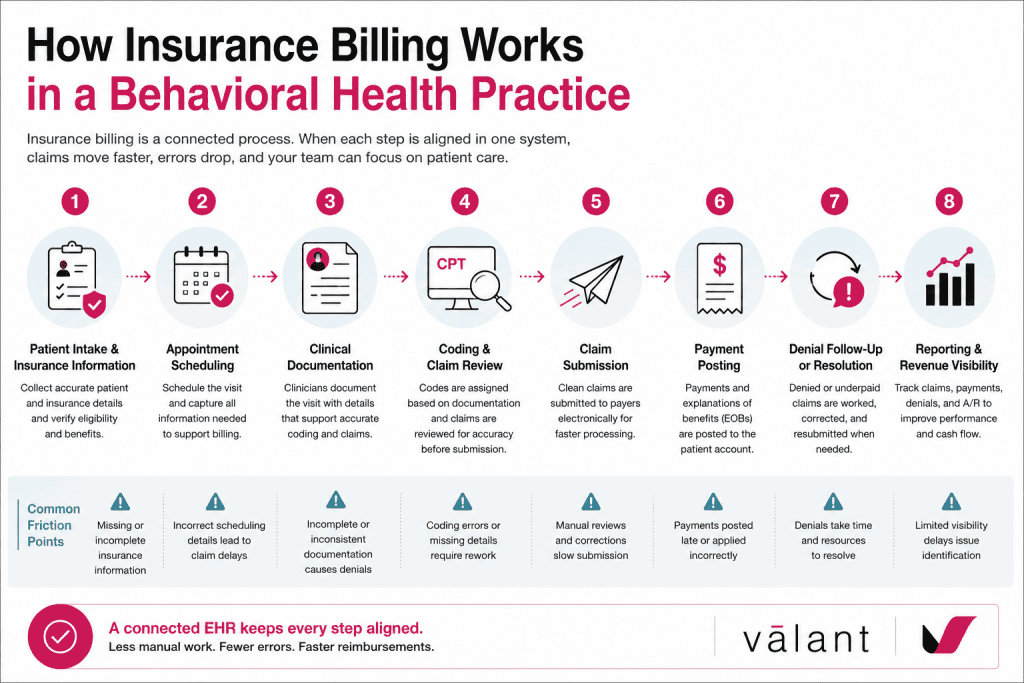
The process usually begins with intake, scheduling, insurance information, and benefit-related workflows. Once the patient is seen, the visit needs documentation that supports coding and claim submission. From there, billing staff review the claim, submit it, track its status, post payments, and follow up on anything that needs attention.
That process gets harder when your team is working across disconnected tools. A scheduler may have one set of information. A clinician may document in another place. Billing may happen somewhere else entirely. The more handoffs your practice relies on, the easier it is for billing mistakes, delays, or rework to enter the process.
That’s why behavioral health practices often ask not just how to bill insurance, but how to bill insurance more efficiently. The answer often comes back to workflow.
Why Behavioral Health Insurance Billing Gets Complicated So Quickly
Behavioral health billing isn’t just about generating claims. It’s about keeping clinical, administrative, and financial processes connected enough that the claim reflects what actually happened.
For many practices, the biggest areas of behavioral health billing problems include:
- Claim denials tied to missed steps
- Incomplete or inconsistent documentation
- Coding issues that slow claim submission
- Manual billing work that takes too much staff time
- Limited visibility into claim status or revenue performance
- Difficulty managing insurance and self-pay side by side
Group practices usually feel this even more. When multiple clinicians are seeing patients, submitting documentation, and relying on shared billing workflows, small inconsistencies can create bigger billing problems over time. This appears as more denials, more staff follow-up, or more work needed just to stay current.
What Behavioral Health Practices Need From an EHR
A behavioral health EHR should support insurance billing as part of a connected workflow, not as an isolated back-office task.
That means your system should help keep scheduling, documentation, billing, and reporting aligned enough that the billing process feels manageable. It should make it easier for your team to move from appointment to claim without repeating work or chasing information across systems.
That’s where connected billing workflows matter. When billing lives in the same environment as the rest of your operational and clinical workflows, your staff spends less time reconciling details and more time moving forward.
A strong setup should help your practice:
- Support claim creation and submission with less manual back-and-forth
- Connect documentation to billing review
- Give staff more visibility into billing activity
- Support both insurance and self-pay workflows within the same broader system
- Make growth easier to manage as provider count and patient volume increase
How to Bill Insurance for Therapy Sessions More Cleanly
Therapy billing gets harder when staff have to piece together visit details after the fact.
A cleaner workflow starts with connecting the basics. The scheduled visit should feed into the rest of the process.
The clinical note should support the billed service. Billing staff should have a clear path to create and review the claim. If something needs attention before submission, the team should be able to catch it early.
That doesn’t mean a platform should promise perfect claims or fully automated billing decisions. It means the system should reduce manual friction.
Valant supports this by keeping key workflows in one environment. Scheduling, documentation, billing, and reporting stay closer together, which can help practices reduce duplicate work and create a more consistent billing process across visits and providers.
For practices dealing with more complex claim review needs, tools like Claim Assist can add another layer of pre-submission safeguard support. That kind of review matters because once a claim goes out with missing or inconsistent information, the cleanup work usually takes much longer than the original review would have.
Supporting Both Insurance and Self-Pay in One System
Many behavioral health practices don’t operate in an insurance-only world.
They may bill some patients through insurance and others through self-pay. They may collect balances after insurance. They may need to manage patient responsibility, statements, and payment workflows while still tracking insurance claims and reimbursements.
That’s one reason integrated billing matters so much. If your EHR only supports part of the financial workflow well, your team ends up stitching the rest together manually.
A better behavioral health billing workflow should make it easier to work across both insurance and self-pay without forcing staff into separate, disconnected processes. That doesn’t just support billing efficiency. It also affects the patient experience.
Clear balances, cleaner communication, and fewer billing surprises reduce confusion for patients and reduce front-desk workload for your team.
Why Group Practices Need More Operational Visibility
As practices grow, billing gets harder to manage by memory and manual follow-up alone.
A solo provider may be able to keep close tabs on claims, documentation, and payments through a simple or manual workflow. A multi-practice group often can’t. Once you have more clinicians, more appointments, and more claims moving through the system, the practice needs stronger visibility into what’s happening financially.
That’s where reporting becomes critical. Your team should be able to see billing performance clearly enough to identify issues earlier, whether that means claim delays, denial patterns, aging receivables, or reimbursement bottlenecks.
Without that visibility, it’s harder to know where the real issue sits. The problem may look like slow payment when the actual issue is documentation inconsistency, claim creation timing, or a recurring payer-related obstacle.
That’s also why practices benefit from understanding broader payer complexity. Our guide to navigating complex payer rules in behavioral health is a helpful resource for teams that need to think more strategically about billing challenges beyond day-to-day claim work.

What to Look For in an EHR if Insurance Billing is a Priority
If insurance billing is a major part of your practice, the right EHR should make a few things easier.
- Connected Workflows: Your scheduling, documentation, and billing processes should support each other. The more disconnected they are, the more work your team has to do to reconcile them.
- Billing Visibility: You need insight into claims, payments, denials, and accounts receivable. Without this data, it’s harder to manage performance and improve it.
- Behavioral Health Fit: Generic medical systems don’t always support behavioral health workflows cleanly. Your EHR should reflect how therapy, psychiatry, and group practices truly operate.
- Support For Growth: As your practice adds providers, locations, or service lines, the billing workflow should stay manageable. If growth adds too much manual overhead, the system may not be supporting your long-term needs well.
- A Better Path to Review Before Submission: Your team should have a clearer way to catch issues before claims go out. That won’t eliminate every problem, but it can help reduce avoidable rework.
When Additional Billing Support Makes Sense
Some practices need more than software support alone.
If your team is dealing with persistent denials, inconsistent follow-up, limited billing capacity, or difficulty maintaining financial visibility, it may make sense to consider additional operational support. That’s where Revenue Cycle Management services come in.
For practices that need help monitoring claims, managing denials, and supporting overall billing performance, dedicated specialists can help reduce internal burden while keeping the revenue cycle moving more consistently.
Insurance Billing Shouldn’t Slow Down the Rest of Your Practice
Billing affects more than reimbursement. It affects staff workload, operational confidence, and your ability to grow.
When your EHR supports insurance billing comprehensively, your team can spend less time untangling fragmented workflows and more time focusing on patient care, billing consistency, and practice performance. That’s crucial in behavioral health, where clinical work is already complex enough without billing systems making the administrative side harder than it needs to be.

See How Valant Supports Behavioral Health Billing
If your practice is trying to make insurance billing more manageable, start by looking at the workflow itself.
Explore Valant’s Behavioral Health Billing Software to see how a connected EHR helps your team streamline claims, reduce manual friction, and get better visibility into billing performance.




Frequently Asked Questions About Insurance Billing For Behavioral Health
Which EHR supports both insurance and self-pay seamlessly?
Practices usually need a system that keeps billing workflows connected enough to support both insurance claims and patient payment responsibilities in the same broader process. The advantage of an integrated behavioral health EHR is that scheduling, documentation, billing, and financial visibility stay closer together, which can reduce manual work across both insurance and self-pay.
If your practice is managing both insurance and self-pay, you need more than billing features on paper. You need workflows that actually stay connected. Valant is built to support behavioral health practices that need scheduling, documentation, billing, and patient payment workflows to work together in one system. That makes it easier to manage insurance claims, patient balances, and follow-up without forcing your team into disconnected processes.
How do you bill insurance for behavioral health services?
Behavioral health insurance billing usually starts with accurate patient and insurance information, followed by scheduling, documentation that supports coding, claim creation, submission, and follow-up. The challenge is that many practices try to manage those steps across too many tools.
Valant helps bring those workflows together so your team can move from appointment to claim with less manual work and better visibility into what’s happening.
How do you bill insurance for therapy sessions?
Therapy billing works best when the visit, documentation, and claim workflow stay aligned. That includes clear visit details, documentation that supports the billed service, and a billing process that helps staff review and submit claims without piecing information together from multiple systems. That’s where many systems fall short.
Valant helps behavioral health practices keep scheduling, clinical documentation, and billing closer together, so staff don’t have to spend as much time piecing together the story of the encounter before sending the claim.
How does insurance billing work for mental health clinics?
Mental health clinics usually manage insurance billing across a chain of connected steps: intake, scheduling, documentation, billing review, claim submission, payment posting, and denial follow-up. As clinics grow, the challenge is keeping those workflows consistent enough across clinicians and staff that billing stays manageable.
Valant is designed specifically for behavioral health, which means practices can manage insurance billing in a system that reflects how mental health clinics actually operate, not how a generic medical office works.
How do group practices streamline insurance billing for therapy?
Group practices usually streamline billing by reducing fragmentation. When multiple clinicians are involved, practices need stronger consistency across scheduling, documentation, billing review, and reporting. A connected behavioral health EHR helps support that by reducing manual handoffs and giving the team better visibility into billing activity.
Valant helps group practices work more efficiently by keeping those workflows in one behavioral health-specific system. That gives teams a better foundation for scaling billing operations without adding as much administrative drag.
What’s the best EHR for behavioral health insurance billing?
The best fit is usually the one that supports behavioral health-specific workflows, keeps documentation and billing aligned, improves visibility into financial performance, and makes it easier for the practice to grow without adding unnecessary administrative burden. For many teams, that means looking closely at how billing actually works inside the platform, not just whether billing features exist.
That’s where Valant stands out. Instead of asking practices to adapt generic workflows to behavioral health, Valant supports the way behavioral health teams actually work, which makes billing easier to manage as your practice grows.
Track Your Progress with 20 KPIs
To help your clients find out what’s working and what could be better, set and track key performance indicators. Learn what KPIs your clients should track to measure progress and identify areas for improvement.