


Modifiers are small. The hard part is that the problems they create usually aren’t.
For behavioral health practices, a missing or incorrect modifier slows reimbursement, triggers claim rework, raises compliance concerns, and frustrates teams that are already stretched thin. It doesn’t take a major billing breakdown to create operational drag. Sometimes it’s a small detail attached to an otherwise correct claim.
That’s part of what makes modifier workflows so frustrating. The work itself can seem minor, but the consequences of inconsistency are not.
Therapy, psychiatry, telehealth, and higher-acuity programs like intensive outpatient program (IOP) and partial hospitalization program (PHP) all bring different billing demands. Add payer variation, manual data entry, and disconnected systems, and modifiers quickly become one more place where practices lose time and confidence.
Behavioral health teams shouldn’t have to treat modifier management like a side project. The right EHR makes modifier workflows easier to manage inside the broader billing process, with less manual reconciliation between scheduling, documentation, and claims preparation.
Why Modifiers Create So Much Friction In Behavioral Health
Most billing teams don’t struggle with modifiers because they don’t understand their importance. They struggle because modifier workflows often sit at the intersection of too many moving parts.
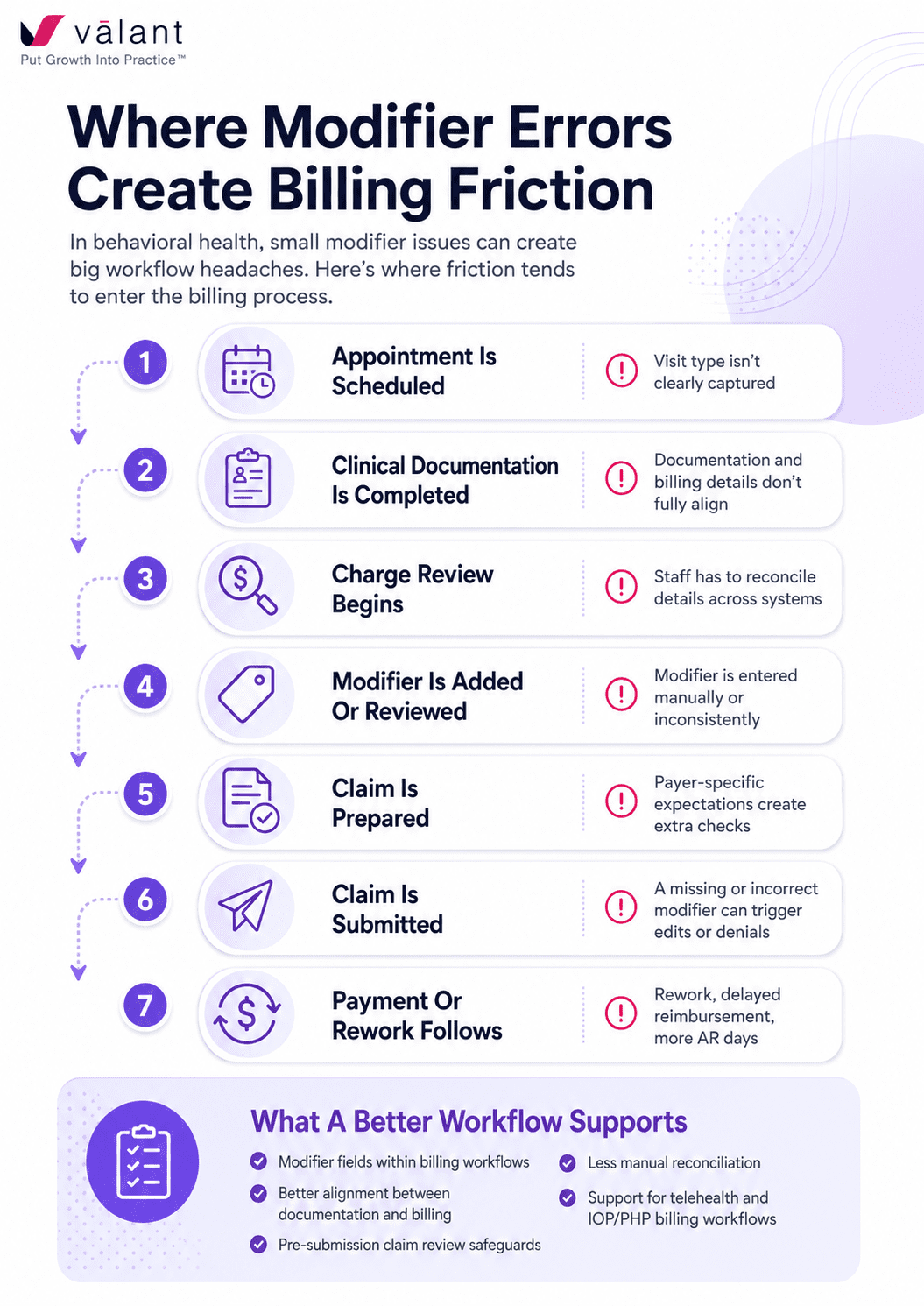
A clinician completes the note. A scheduler records the appointment type. A biller reviews the claim. A payer has its own expectations.
Telehealth adds another layer. IOP and PHP introduce institutional billing requirements. If those details don’t line up cleanly, the modifier becomes one more point of failure.
That friction tends to show up in several familiar ways:
- Manual modifier entry that depends on staff memory
- Payer-specific variation that’s hard to track consistently
- Reworked claims after denials or edits
- Billing teams spending too much time checking small details
- Training headaches when workflows vary across programs or clinicians
- Disconnected documentation and billing records that make reconciliation harder
This is one reason billing often feels more complex than it looks from the outside. The operational burden is rarely one issue.
It’s the accumulation of small steps that don’t connect well. If that sounds familiar, this breakdown of the unexpected burden of billing for small behavioral health practices adds useful context.
What Behavioral Health Practices Need from Modifier Workflows
An EHR doesn’t need to make coding decisions for the billing team, but it does need to support cleaner workflows.
That means modifier fields should be part of the billing process in a way that feels structured, visible, and connected to the rest of the claim workflow. Staff should be able to work within a system that supports documentation, billing review, and claim preparation without depending on disconnected spreadsheets, workarounds, or repeated manual checks.
For behavioral health organizations, that support matters in a few areas:
- Telehealth services that may require modifier-related review
- Psychiatry and therapy workflows with different billing patterns
- Institutional billing for IOP and PHP programs
- Staff training for teams that need a more consistent process
- Pre-submission safeguards that help catch issues before claims go out
The goal isn’t fully autonomous logic. It’s fewer avoidable headaches.
Telehealth Modifier Workflows Shouldn’t Feel Fragile
Telehealth is one of the clearest examples of how small billing details can create outsized operational risk.
Practices need to be prepared for telehealth-related billing requirements, but they also need a workflow that doesn’t fall apart every time a payer expects a different combination of details. If modifier handling depends entirely on memory, side notes, or disconnected steps between scheduling and billing, errors are more likely to occur.
A better approach is managing telehealth billing workflows in the same environment where scheduling, clinical documentation, and billing activity already live. That makes it easier for teams to see the context around the visit, review claim details more confidently, and reduce the amount of manual reconciliation required before submission.
This is where integrated billing workflows matter. Modifier handling becomes more manageable when it’s part of a connected process instead of a separate task staff have to remember at the last minute.
IOP and PHP Billing Raise the Stakes
Modifier-related complexity becomes even more important for practices running IOP and PHP programs.
These organizations aren’t just dealing with outpatient claims. They often need workflows that support institutional billing, including 837i and UB-04 requirements, along with the broader structure around units, revenue codes, and claim review. When those details are handled across disconnected systems, the risk of delay and rework goes up fast.
That doesn’t mean a platform should promise automatic payer-specific logic or guaranteed denial prevention. It does mean the workflow should support more organized claim preparation and better alignment between operational, clinical, and billing records.
For IOP and PHP programs, clean handoffs matter. Attendance, documentation, charge review, and billing details need to stay connected enough that teams can prepare claims with more confidence and less backtracking. If modifier handling is one more factor floating outside that process, it becomes harder to manage institutional billing at scale.
Documentation and Billing Need to Stay Closer Together
One of the biggest reasons modifier workflows break down is the information billers need often lives too far away from the claim itself.
When documentation, scheduling, and billing operate in separate systems, staff end up piecing together the story of the session after the fact. That creates room for inconsistency, especially when modifier use depends on service type, program type, or visit context.
A stronger EHR workflow keeps those records closer together. It doesn’t replace billing judgment, but it does reduce the amount of manual detective work required to prepare claims accurately.
That’s especially important as practices grow. More clinicians, more services, and more locations usually mean more billing variation.
Without better workflow support, modifier issues can become one more source of staff burnout. For larger organizations dealing with that kind of pressure, this post on the unexpected burden of billing at scale for large behavioral health practices is worth reading.
Safeguards Matter Before Claims Go Out
By the time a claim is denied, the damage is already done.
The team has to investigate the issue, rework the claim, resubmit it, and wait longer for payment. That delay affects revenue, accounts receivable (AR) days, and staff capacity. Even when the fix is straightforward, the interruption is costly.
That’s why pre-submission safeguards matter. A behavioral health EHR should support cleaner billing review before claims are sent, helping teams catch issues earlier in the workflow. Tools like Claim Assist can help practices add another layer of review before submission, which is especially valuable when claims depend on multiple operational details lining up correctly.
That’s not the same as guaranteed denial prevention. It’s better described as workflow protection: more visibility, more structure, and fewer preventable mistakes making it out the door.
For practices that want broader support beyond software workflows alone, Revenue Cycle Management may also be part of the conversation. When claim preparation, follow-up, and billing oversight need added support, connected operational workflows matter even more.

Staff Training Gets Easier When the Workflow is Clearer
Modifier confusion isn’t just a system problem. It’s also a training problem.
When billing teams have to memorize too many exceptions or rely on informal workarounds, training becomes inconsistent. One biller may know exactly how a certain scenario is usually handled. Another may not. That creates avoidable variation across the team.
A cleaner EHR workflow helps by making modifier-related work more visible and repeatable. Staff still need judgment and oversight, but they benefit from a system that supports a more consistent process. That’s especially helpful for practices onboarding new billing staff, cross-training team members, or trying to reduce rework across multiple service lines.
Confidence matters here. Teams work better when they can trust the workflow, not just the memory of the person who’s been there the longest.
What “Handling Modifiers Cleanly” Should Really Mean
For behavioral health practices, an EHR that handles modifiers cleanly should accomplish a few outcomes well:
- Include modifier fields within billing workflows
- Support organized review before claim submission
- Keep documentation and billing records better connected
- Reduce manual reconciliation between scheduling, documentation, and claims
- Support institutional billing workflows for IOP and PHP programs
- Make training easier through more consistent operational processes
What it shouldn’t promise is magic.
Practices still need to manage payer expectations, review claim details carefully, and apply billing judgment. But they shouldn’t have to fight their EHR to excel.
That’s the real issue. Modifiers may be small billing details, but they can create major operational headaches when workflows are fragmented.
A better behavioral health EHR doesn’t make those realities disappear. It helps your team/s manage them with less friction, fewer revisions, and more confidence.
Make Modifier Workflows Easier to Manage
If billing modifiers are creating more rework than they should, the problem often isn’t just training. It’s the workflow.
Explore Valant’s billing capabilities to see how a connected behavioral health EHR can help your team reduce manual friction, strengthen billing review, and manage claims with more confidence.



Frequently Asked Questions About Billing Modifiers in Behavioral Health
What are the most common billing modifiers in telehealth right now?
Telehealth-related billing modifiers can vary based on payer, setting, and claim requirements. What matters operationally is having a workflow that helps your team review and apply the right billing details consistently, rather than relying on memory or disconnected manual steps.
What billing modifiers do I need to be prepared for with my telehealth practice?
Telehealth practices should be prepared for modifier-related requirements that can differ by payer and service type. The key is making sure your billing workflow supports review, consistency, and cleaner coordination between the visit, the documentation, and the claim.
Does Valant offer common telehealth billing modifiers in its platform?
Valant supports billing workflows that include modifier fields and integrated claim preparation steps, which can make telehealth billing easier to manage within the platform. The value is in workflow support, configuration flexibility, and reduced manual friction across connected records.
How easy is it to work with telehealth billing modifiers within Valant’s platform?
Modifier workflows are easier to manage when billing, documentation, and operational details are connected in one environment. That reduces the need for manual reconciliation and makes it easier for teams to prepare and review telehealth-related claims as part of the broader billing workflow.
How do we correctly bill IOP services on a UB-04, including revenue codes, modifiers, and units?
IOP billing requires close attention to institutional billing structure, including UB-04 or 837i workflows, along with the claim details your program and payers require. The most important factor is having a system and process that support organized review and reduce fragmentation between documentation, attendance, charge review, and billing preparation.
Track Your Progress with 20 KPIs
To help your clients find out what’s working and what could be better, set and track key performance indicators. Learn what KPIs your clients should track to measure progress and identify areas for improvement.