
Taking detailed notes is an integral part of providing high-quality care in mental health. Clinical documentation is useful in sharpening the understanding of patient problem areas, tracking the progress of care, creating effective treatment plans, and, depending on the nature of your practice, is a requirement for payers or regulatory bodies.
For many clinicians, however, documentation is also one of the most time-consuming parts of the job. Therapists often spend hours each week completing notes, coding sessions, and finalizing documentation after appointments.
This has led to a long-standing conversation in behavioral health: what is the best way to document a session while still maintaining a strong therapeutic connection with the patient?
Today, clinicians typically use one of three approaches:
- Writing notes after the session
- Taking partial notes during the session
- Completing concurrent documentation in the EHR
Each method has advantages and tradeoffs. Increasingly, new technology—particularly AI-assisted documentation—has begun to reshape how providers approach this decision.
Documenting After the Session
A popular approach to note-taking is to completely skip it while in session and complete documentation afterward.
The biggest benefit of this method is simple: providers can offer their complete focus and emotional availability without any physical impediments to the patient. Without typing or writing during the session, therapists can maintain eye contact, observe nonverbal cues, and remain emotionally present. This can be especially helpful during early sessions when building trust is critical.
However, documenting from memory introduces several challenges:
- Important details can be forgotten or misremembered
- Clinicians may feel mental pressure to remember key points during the session
- Notes often take longer to complete after the fact
- Documentation can spill into evenings or weekends
When schedules are full and sessions run back-to-back, documentation delays can compound quickly. Providers may find themselves trying to remember the details of multiple sessions hours later.
Over time, this documentation backlog becomes a major source of administrative burden and clinician burnout.
Partial Notes on Paper
Another common approach is to take brief notes during the session on a paper pad or notebook, then complete the formal documentation later. This method can help capture key clinical details without introducing too much disruption into the session. Many patients perceive handwritten notes as less distracting than typing on a laptop or tablet.
However, this approach still requires clinicians to:
- Translate handwritten notes into the EHR
- Expand brief notes into full clinical documentation
- Complete coding and compliance elements after the session
In other words, while this method captures the essential information, it often does not reduce the overall documentation workload. For many providers, it simply moves the documentation work to another part of the day.
Concurrent Documentation
Concurrent documentation in mental health refers to completing clinical documentation in real time during or immediately after a session within the EHR. It’s becoming more common as behavioral health technology evolves. With this method, clinicians document key elements of the session in real time.
This ensures:
- Details are captured accurately
- Documentation is completed more quickly
- Notes are ready shortly after the session ends
For busy practices, concurrent documentation can reduce the risk of accumulating unfinished notes and help clinicians stay on top of compliance requirements.
However, this approach has been historically controversial in mental health settings.
Therapy relies heavily on human connection. Introducing a laptop or tablet into the session can sometimes feel like a barrier between the clinician and the patient. Some providers worry that typing notes during the conversation may appear distracting or disengaged.
This tension between clinical presence and documentation efficiency is one of the biggest workflow challenges in behavioral health.
How AI Is Changing Clinical Documentation
Recent advances in AI-assisted documentation are beginning to change how behavioral health clinicians approach note-taking. Instead of manually writing notes during or after a session, clinicians can now use tools that transcribe sessions and generate structured draft notes automatically. These drafts can then be reviewed, edited, and finalized by the provider inside the EHR.
Valant’s AI Notes Assist, for example, can generate structured notes aligned with common behavioral health documentation formats such as:
- SOAP notes
- DAP notes
- BIRP notes
- Narrative documentation
- Custom clinical templates
The system can also surface CPT-aligned documentation suggestions to support accurate coding and compliance based on the session content. For many clinicians, this creates a new middle ground between traditional documentation approaches.
Instead of choosing between being present with the patient and capturing detailed notes, AI-assisted documentation allows clinicians to focus on the session while technology helps organize the documentation afterward.
Because the generated notes are fully editable, clinicians remain in control of the final clinical record and can ensure it reflects their professional judgment.
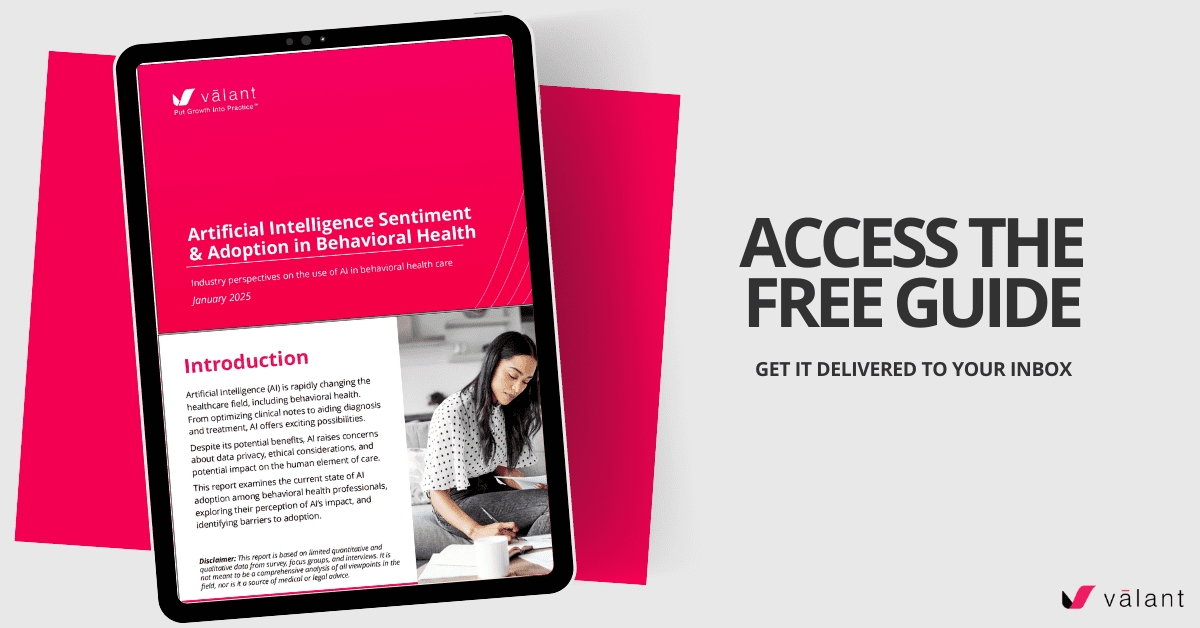
To learn more, check out our guide on the role of AI in behavioral health.
Finding the Right Documentation Workflow
Ultimately, there is no single documentation method that will work perfectly for every provider. Mental health practices will need to balance several priorities:
- Maintaining strong therapeutic relationships
- Meeting documentation and compliance requirements
- Managing time between sessions
- Preventing clinician burnout
- Supporting practice growth
Some clinicians will prefer documenting after sessions to maintain uninterrupted patient interaction. Others can benefit from concurrent documentation workflows that keep notes current throughout the day. And now, many practices are exploring AI-assisted documentation as a way to reduce administrative workload without sacrificing patient connection.
The goal is not to replace the clinician’s expertise, but to support it—giving providers more time to focus on care while technology helps handle the mechanics of documentation.
See How AI Notes Assist Supports Behavioral Health Documentation
Documentation should support your clinical work—not slow it down.
Valant’s AI Notes Assist is designed specifically for behavioral health practices, helping clinicians generate structured draft notes, surface CPT-aligned documentation suggestions, and finalize records directly inside the EHR.
By reducing the time spent writing and organizing notes, clinicians can spend more time focused on their patients and less time catching up on documentation after hours.
Request a demo today to see how AI Notes Assist fits seamlessly into your existing documentation workflow.